Molnlycke
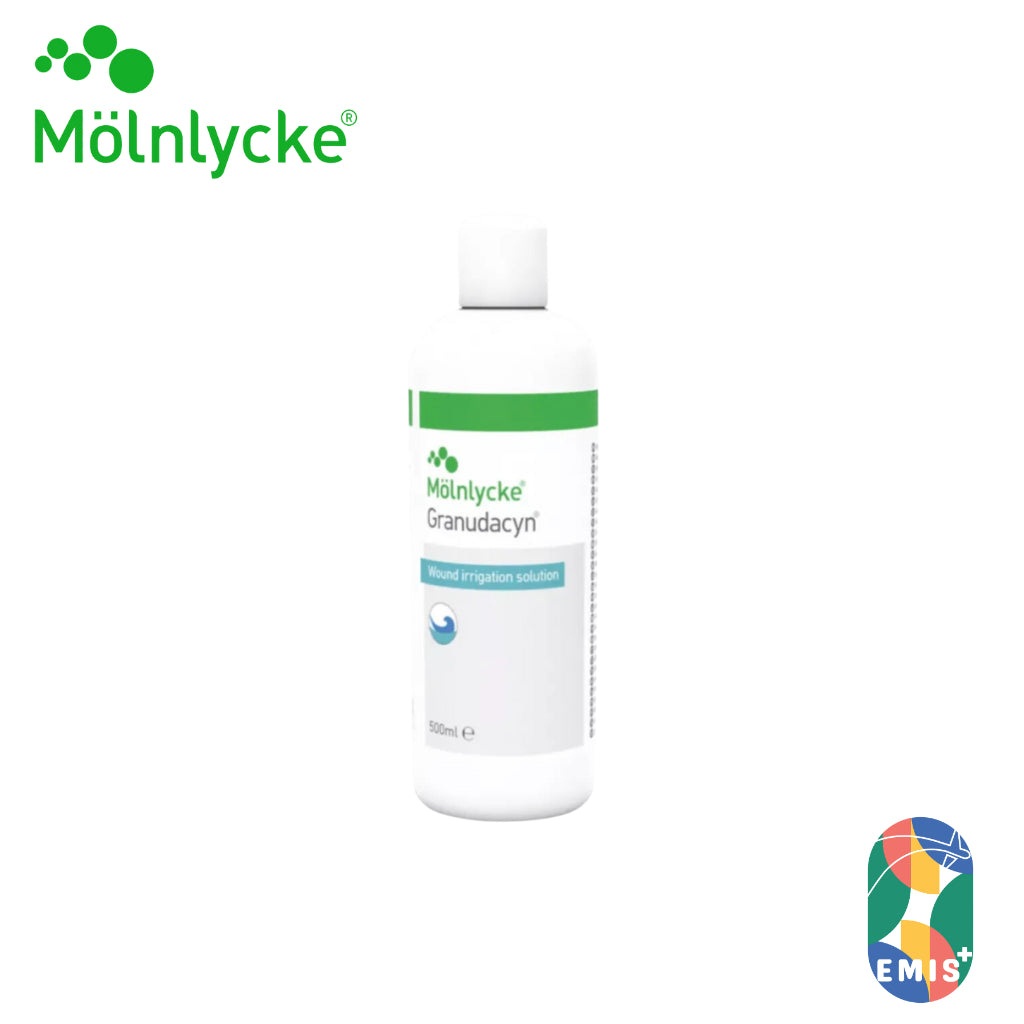
Molnlycke Granudacyn Wound Irrigation Solution 500ml for Cleansing and Moisturising
Molnlycke Granudacyn Wound Irrigation Solution 500ml for Cleansing and Moisturising
Couldn't load pickup availability
Mölnlycke Granudacyn® Wound Irrigation Solution 500 ml — Product Overview
Granudacyn® leverages the antimicrobial mechanism of hypochlorous acid (HOCl), the same oxidant produced by neutrophil granulocytes during the innate immune response. At the concentration formulated in Granudacyn, HOCl disrupts bacterial cell membranes, oxidises virulence-associated proteins, and impairs biofilm matrix integrity without inducing resistance. Unlike povidone-iodine or chlorhexidine, Granudacyn has been demonstrated in in vitro and ex vivo models to be non-cytotoxic to human fibroblasts and keratinocytes (PMID: 36367808), making it suitable for use in wounds where tissue regeneration must be preserved alongside bacterial load reduction.
The 500 ml format is designed for wound irrigation in clinic and home settings, with a multi-patient shelf life of 60 days after opening when stored as directed. The solution is isotonic and pH-neutral, preventing osmotic damage to granulation tissue. It is suitable for use on wounds with exposed tendon, cartilage, ligament, or bone, and for irrigation of body cavities including ear, nose, and mouth. Granudacyn is stocked in Singapore restructured hospitals, home nursing agencies, and community care facilities as a first-line wound cleansing agent in line with the WUWHS Consensus Document on Wound Infection (2016) and Singapore MOH Clinical Practice Guidelines on Wound Care.
Specifications
| Manufacturer | Mölnlycke Health Care AB, Gothenburg, Sweden |
|---|---|
| Active Ingredient | Hypochlorous acid (HOCl) at physiological pH |
| Volume | 500 ml |
| Presentation | Irrigation solution in screw-cap bottle |
| Antimicrobial Spectrum | Gram+/−, MRSA, VRE, Pseudomonas, fungi, viruses, spores |
| Cytotoxicity | Non-cytotoxic to fibroblasts and keratinocytes at therapeutic concentration |
| pH | Physiological (6.5–7.5) |
| Shelf Life After Opening | 60 days (solution); 90 days (gel variant) |
| Sterility | Non-sterile; suitable for multi-patient use |
| Regulatory Status | CE-marked, EU MDR 2017/745; ISO 13485:2016 quality management |
Clinical Indications
- Chronic wounds (all types): Diabetic foot ulcers, pressure injuries, venous leg ulcers, and arterial ulcers with any level of bacterial colonisation or biofilm burden, per EWMA and WUWHS irrigation consensus guidelines.
- Acute traumatic wounds: Lacerations, bites, abrasions, and degloving injuries; effective for debridement irrigation to reduce particulate and bacterial load prior to closure or primary dressing application.
- Surgical wounds: Intraoperative and postoperative wound irrigation for contaminated or clean-contaminated surgical sites; used to reduce surgical site infection (SSI) risk in accordance with WHO SSI Prevention Guidelines 2016.
- Burns (1st and 2nd degree): Gentle antimicrobial irrigation that does not impair epithelial regeneration in superficial and partial-thickness burns during the proliferative phase.
- Infected or critically colonised wounds: Effective against polymicrobial biofilm communities including MRSA, providing clinically meaningful log-reduction in bacterial counts as demonstrated in the 3D collagen wound biofilm model (PMID: 36367808).
- Body cavity and peri-wound cleansing: Suitable for irrigation of fistulae, abscesses, and ear/nasal/oral cavities under clinical supervision.
Frequently Asked Questions
How does Granudacyn differ from saline (0.9% NaCl) as a wound irrigation solution?
Normal saline provides mechanical cleansing through irrigation force but lacks intrinsic antimicrobial activity and does not address biofilm. Granudacyn provides equivalent mechanical cleansing with the addition of HOCl-mediated antimicrobial action effective against planktonic bacteria and established biofilm communities, making it the preferred option for critically colonised or infected wounds per WUWHS 2016 consensus on wound infection management.
Is Granudacyn safe to use on wounds with exposed bone or tendon?
Yes. Unlike iodine-based solutions, Granudacyn's non-cytotoxic profile makes it appropriate for wounds with exposed deep structures. Clinical practice in Singapore tertiary centres uses Granudacyn for orthopaedic wound irrigation where tissue viability preservation alongside infection management is required. Always follow the prescribing clinician's instructions for wound depth and exposed structure management.
Can Granudacyn be used on paediatric patients?
Granudacyn has been used in paediatric wound care settings, particularly for burn management and chronic wounds. The non-cytotoxic, pH-neutral formulation is well-tolerated on sensitive skin. Clinicians should follow local paediatric wound care protocols and consult the product IFU; no specific age restriction is listed in the manufacturer's indications for irrigation use.
What is the correct irrigation technique for a deep cavity wound?
For cavity wounds, Granudacyn should be delivered via a 19-gauge blunt cannula or standard irrigation syringe at a pressure of 4–15 PSI (as recommended by RNAO Best Practice Guidelines for Wound Care) to ensure penetration without driving bacteria deeper into tissue. The cavity should be filled and allowed to dwell for 1–2 minutes before drainage to maximise antimicrobial contact time.
Is Granudacyn Wound Irrigation Solution available for bulk procurement by Singapore healthcare facilities?
Yes. EMIS+ supplies Granudacyn to Singapore hospitals, polyclinics, home nursing agencies, and community care teams. Institutional procurement enquiries including bulk pricing, consignment arrangements, and product technical documentation (CE certificate, IFU, MSDS) can be directed to the EMIS+ B2B team via the contact page.
Share