Buzud
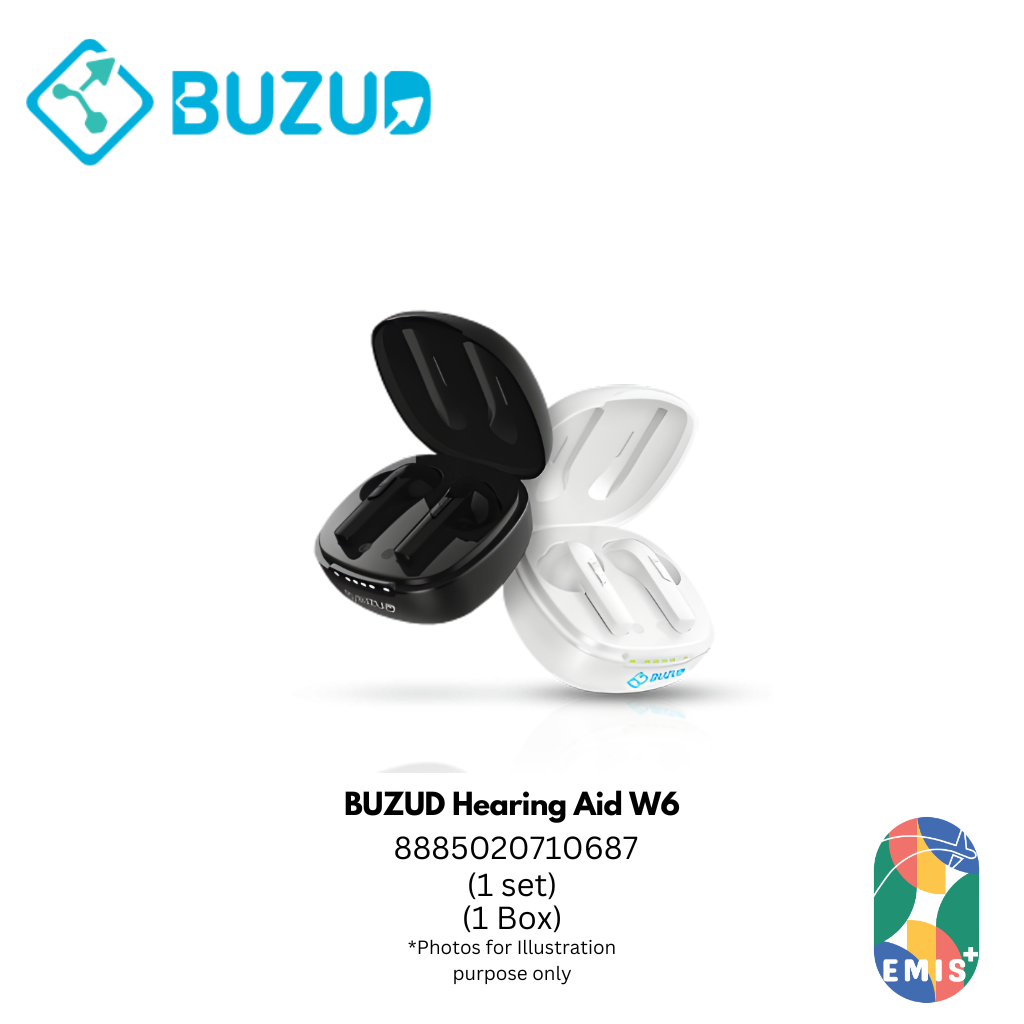
BUZUD Hearing Aid W6
BUZUD Hearing Aid W6
Couldn't load pickup availability
A digital, Bluetooth-enabled receiver-in-canal (RIC) hearing aid indicated for mild to moderate sensorineural hearing loss in adults. Features dual-microphone directional processing, active noise reduction, a frequency response of 200–7,540 Hz, and OSPL90 of 105 dB. App-controlled via smartphone for personalised gain adjustment and programme selection. Approved by the Health Sciences Authority (HSA) Singapore as a Class B medical device. Supplied with a portable wireless charging case.
Technical Specifications
| Parameter | Value |
|---|---|
| Device Type | Digital Receiver-in-Canal (RIC) hearing aid |
| Indication | Mild to moderate sensorineural hearing loss |
| Frequency Range | 200 Hz – 7,540 Hz |
| OSPL90 (Max Output) | 105 dB ± 4 dB SPL |
| Equivalent Input Noise | 19.7 dB SPL |
| Total Harmonic Distortion (THD) | 0.3% |
| Microphone System | Dual microphone — directional with noise reduction algorithm |
| Connectivity | Bluetooth — iOS and Android app control for gain, programme, and EQ adjustment |
| Working Current | 10 mA |
| Operating Temperature | -10°C to +40°C; 30–75% RH (non-condensing) |
| Storage Conditions | -10°C to +55°C; 10–90% RH |
| Charging Case Input | DC 5.0 V / 1 A (USB-C) |
| Charging Case Output | DC 4.2 V / ≤100 mA per aid |
| Regulatory Approval | HSA Singapore approved — Class B medical device |
| Standard Compliance | IEC 60118-0 (hearing aids — measurement); ISO 21388 (hearing aid fitting management) |
Clinical Indications
- Mild to moderate sensorineural hearing loss (SNHL) in adults — pure-tone average (PTA) 26–70 dB HL across 500 Hz–4 kHz
- Age-related hearing loss (presbycusis) — gradual high-frequency SNHL in adults aged ≥50
- Noise-induced hearing loss (NIHL) — permanent SNHL following occupational or recreational noise exposure
- Post-medical management hearing loss stabilised after otological treatment (e.g. post-otitis media, post-ototoxic drug exposure)
- Patients requiring discreet, app-controlled amplification with Bluetooth audio streaming capability
Community Consensus: Clinical Q&A
Q: What degree of hearing loss does the W6 address — and who should see an audiologist first?
The BUZUD W6 is indicated for mild to moderate hearing loss, corresponding to a pure-tone average of 26–70 dB HL. Individuals with severe (71–90 dB HL) or profound (>90 dB HL) loss require a higher-powered hearing aid and should be assessed by a registered audiologist or ENT specialist before device selection. A baseline audiogram is recommended before purchasing any hearing aid, as it establishes the degree and configuration of loss and confirms whether amplification alone is appropriate — conductive hearing loss (e.g. from middle ear effusion or otosclerosis) may be surgically correctable and should be excluded before fitting an amplification device.
Q: How significant is the 19.7 dB equivalent input noise (EIN) level for daily use?
EIN of 19.7 dB SPL is the level of internal electronic noise the microphone system introduces — lower EIN means quieter background noise during amplification. The IEC 60118-0 standard specifies EIN as a key performance indicator for hearing aids. A value of 19.7 dB is clinically acceptable for mild-moderate loss fitting; premium audiological-grade devices may achieve 15–18 dB EIN. For typical daily listening environments (conversational speech, television, telephone), this EIN level is unlikely to be perceptible above ambient noise.
Q: Does the W6 require fitting by a registered audiologist in Singapore?
The BUZUD W6 is an HSA-registered hearing aid. In Singapore, hearing aids are classified as medical devices and may be purchased without a mandatory audiologist prescription — however, the Singapore Association for the Deaf and the Allied Health Professions Council strongly recommend audiological assessment and fitting verification before use. Proper fitting (gain verification via real-ear measurement, or at minimum audiogram-matched programming) significantly improves speech intelligibility outcomes. EMIS recommends all W6 purchasers undergo a baseline audiogram before initial fitting adjustment.
Q: What is the OSPL90 and why does 105 dB matter for safety?
OSPL90 (Output Sound Pressure Level at 90 dB input) is the maximum output the hearing aid can produce — the "ceiling" of amplification. At 105 dB SPL, the W6 provides sufficient gain headroom for moderate hearing loss without risking acoustic trauma in listeners with mild loss. The IEC 60118 standard requires OSPL90 to be measured and disclosed to prevent over-amplification injury. For context, hearing damage risk increases significantly above 85 dB SPL with prolonged exposure — the W6's maximum output should be managed via app gain settings to match the individual's audiogram and comfort thresholds.
Share