


Size guide
How to choose your pouch size
Measure your stoma first, then pick a size and cut the opening to fit. A snug opening helps protect the skin around your stoma.
Measure at the base. Hold a stoma measuring guide over your stoma and find the smallest circle that fits around the base without touching it. If your stoma is oval, measure its widest and narrowest points, or make a paper template.
Pick the right size. Choose a pouch whose cut-to-fit range includes your measurement. A one-piece pouch has the baseplate built in, so there is no separate bag to match.
Cut to fit. Trace your size onto the backing paper and cut along the line with small curved scissors.
Check the fit. The opening should hug your stoma with no skin showing. Too small and it presses on the stoma. Too big leaves skin uncovered, where output can make it sore.
Re-measure as it changes. Your stoma usually shrinks over the first 6 to 8 weeks after surgery, so measure it at every change during that time. After that, measure again if your weight changes or you notice leaks or sore skin.
Not sure which size you need? Ask your stoma care nurse, or message us a photo of your current box and the EMIS+ team will help match the code.
Based on patient guides from Hollister, Dansac, Colostomy UK and Oxford University Hospitals NHS. Always follow the leaflet in your box.

What it is for
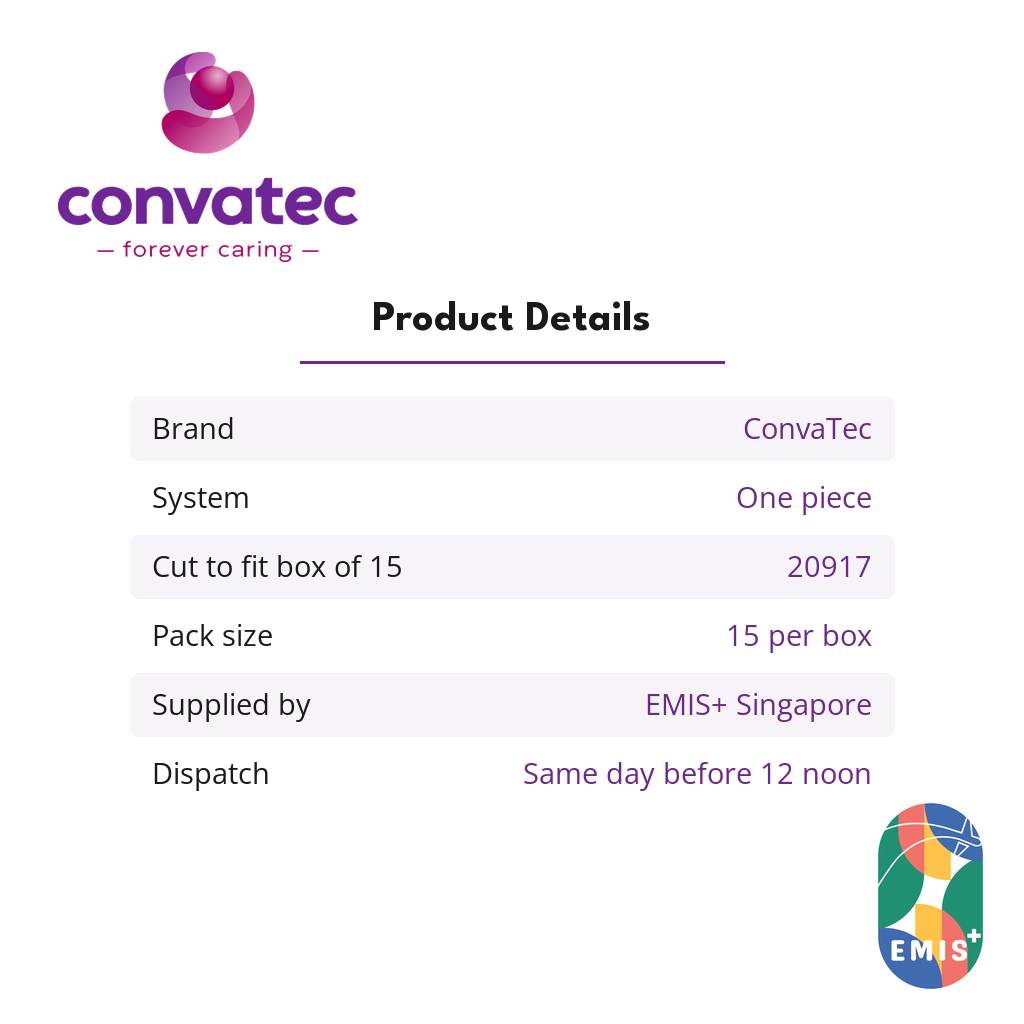
ConvaTec ActiveLife Little Ones One Piece Urostomy Pouch, Paediatric (REF 20917) is a cut-to-fit, one-piece paediatric urostomy pouch with a urine tap outlet. It is scaled for infants and small children and is for paediatric urostomy as prescribed.
Pack: Cut to fit, box of 15 (20917).
Benefits
- Scaled for infants and small children
- Urine tap outlet
- Cut-to-fit one-piece pouch

How to use
- Measure, cut, apply, and empty via the urine tap.
- Follow the Little Ones IFU.
- Do not substitute a cut-down adult urostomy pouch.
- Confirm the fit, size and change interval with a stoma care nurse or doctor, and follow the manufacturer instructions for use supplied with the pack.
Always follow the instructions on the pack and your nurse or doctor's advice.