Molnlycke
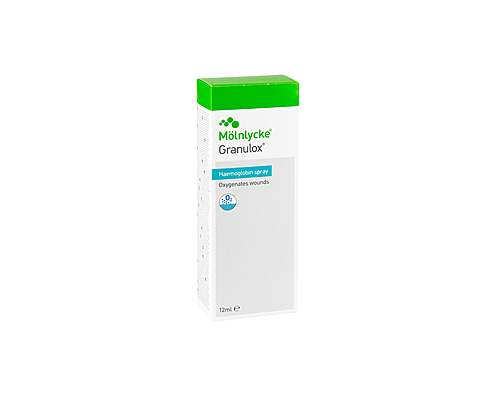
360001 Granulox Topical Haemoglobin Spray 12ml
360001 Granulox Topical Haemoglobin Spray 12ml
Couldn't load pickup availability
Product Overview
Granulox® Topical Haemoglobin Spray is an oxygenating adjunct therapy developed to address tissue hypoxia in chronic, stalled wounds. Wound hypoxia — defined as a partial pressure of oxygen below 20 mmHg in the wound bed — suppresses fibroblast proliferation, keratinocyte migration, collagen synthesis, and neutrophil bactericidal activity, resulting in non-healing or slowly healing wounds. Granulox® corrects this deficit by delivering a thin film of highly purified porcine haemoglobin onto the wound surface; the haemoglobin then binds oxygen from ambient air and releases it via simplified (facilitated) diffusion into the underlying wound tissue, mimicking the physiological role of erythrocyte haemoglobin in oxygen transport.
EMIS Singapore supplies Granulox® 12 ml (REF 360001) for clinical procurement by hospitals, specialist wound care clinics, community health teams, and home care providers across Singapore. The product is compatible with all breathable, non-occlusive secondary dressings and is applied before dressing placement. The 12 ml bottle delivers approximately 200 spray actuations, sufficient for multiple dressing changes over a standard 13-week treatment course. A Singapore-specific case series published in the International Wound Journal (PMID: 32349571) documented complete or near-complete healing in patients with refractory venous leg ulcers and diabetic foot ulcers following adjunct use of Granulox®.
Product Specifications
| Manufacturer | Mölnlycke Health Care AB, Gothenburg, Sweden |
| Product Name | Granulox® Topical Haemoglobin Spray |
| REF / Product Code | 360001 |
| Active Ingredient | Highly purified porcine haemoglobin (spray solution) |
| Volume per Bottle | 12 ml (~200 actuations) |
| Device Classification | Class III Medical Device — EU MDR 2017/745 CE-marked |
| Regulatory Clearance | CE Mark (EU MDR 2017/745); HSA-registered medical device, Singapore |
| Application Method | Spray 1–2 actuations per 10 cm² wound area onto wound bed; cover with breathable non-occlusive secondary dressing |
| Dosing Frequency | Minimum twice weekly; at each dressing change |
| Wound Compatibility | Moderate to heavily exuding chronic wounds; not for occlusive dressing use |
| Storage | Store below 25°C; protect from direct sunlight; do not freeze |
| Quality Standard | Manufactured under ISO 13485:2016 quality management system |
Clinical Indications
- Diabetic foot ulcers (DFU): Adjunct to standard offloading, debridement, and moist wound care in neuropathic or neuroischaemic DFUs with stalled healing; aligned with IWGDF 2023 guidance on topical oxygen therapy.
- Venous leg ulcers (VLU): Used alongside compression bandaging per Singapore MOH clinical practice guidelines; a randomised controlled trial demonstrated 53% wound size reduction vs. 21% increase in standard care at 13 weeks.
- Arterial and mixed-aetiology leg ulcers: Applied as adjunct where underlying ischaemia limits tissue oxygen delivery; requires concurrent vascular assessment.
- Pressure injuries (Stage III–IV): Indicated for hypoxic pressure injuries in immobile or palliative patients with recalcitrant wound beds; applied prior to foam or hydrofibre secondary dressings.
- Post-surgical dehisced wounds: Accelerates secondary intention healing in surgical site dehiscence; pooled cohort evidence (PMID: 29988544, p=0.001) supports use in this wound category.
- Burn wounds (partial thickness): Adjunct to moist wound care in partial-thickness burns to support re-epithelialisation; clinical benefit demonstrated in pooled meta-analysis data.
Frequently Asked Questions
What is the mechanism by which Granulox® delivers oxygen to wound tissue?
Granulox® contains highly purified porcine haemoglobin suspended in a spray solution. When applied to the wound bed, the haemoglobin film binds molecular oxygen from ambient air at the wound surface (partial pressure ~21 kPa) and releases it by facilitated diffusion into the hypoxic wound tissue below (partial pressure typically <3 kPa in chronic wounds). This mimics the physiological oxygen-carrying function of red blood cells without requiring a vascular delivery route, making it effective in ischaemic or poorly vascularised wound beds where systemic oxygen delivery is insufficient.
How does Granulox® interact with different secondary wound dressings?
Granulox® must be used with breathable, non-occlusive secondary dressings that allow ambient air to reach the haemoglobin film. Compatible dressings include foam dressings (e.g., Mepilex®, Allevyn®), alginate dressings, hydrocolloid dressings with perforations, and non-woven contact layers. Occlusive film dressings (e.g., transparent adhesive films applied as a sole dressing) should not be used as secondary covers, as they block the oxygen supply required for haemoglobin saturation. Granulox® is applied first, directly onto the wound bed, then covered with the chosen secondary dressing.
Is Granulox® suitable for infected wounds, and should antimicrobial dressings be used concurrently?
Granulox® is not classified as an antimicrobial agent and does not replace debridement or antimicrobial dressings in critically colonised or clinically infected wounds. However, by improving wound oxygenation, it supports neutrophil bactericidal activity — neutrophil oxidative burst requires adequate tissue oxygen. In wounds with critical colonisation or local infection, antimicrobial primary dressings (e.g., silver alginate, DACC-coated, or iodine-based) may be used as the primary contact layer before applying Granulox® spray, subject to clinician assessment. Systemic antibiotics for clinical infection should be managed per Singapore MOH antimicrobial stewardship guidelines.
What clinical evidence supports Granulox® use, and are there Singapore-specific data?
The evidence base for Granulox® includes multiple retrospective cohort studies and a 2018 pooled meta-analysis (PMID: 29988544) demonstrating significantly improved healing rates across five wound categories when added to standard care. A Singapore-specific case series (PMID: 32349571, published in the International Wound Journal) documented outcomes in Singapore patients with venous leg ulcers and diabetic foot ulcers, supporting the product's clinical relevance in the local care setting. The International Working Group on the Diabetic Foot (IWGDF) 2023 guidelines include a conditional recommendation to consider topical oxygen as adjunct therapy for DFUs failing standard care.
How do Singapore clinics and home care providers procure Granulox® through EMIS?
EMIS Singapore (emis.asia) supplies Granulox® REF 360001 to hospitals, specialist wound care clinics, polyclinics, community nursing providers, and home care settings islandwide. Procurement is available via direct B2B order through the EMIS website or by contacting our clinical supply team. HSA-registered medical device importation and distribution requirements are fulfilled by EMIS as the licensed distributor. Repeat orders can be arranged on standing order for institutions with ongoing wound care programmes. Delivery is available island-wide with same-day or next-day options for urgent clinical needs.
Share