AiYiSheng
Multifunctional Warm Feet Appliance
Couldn't load pickup availability
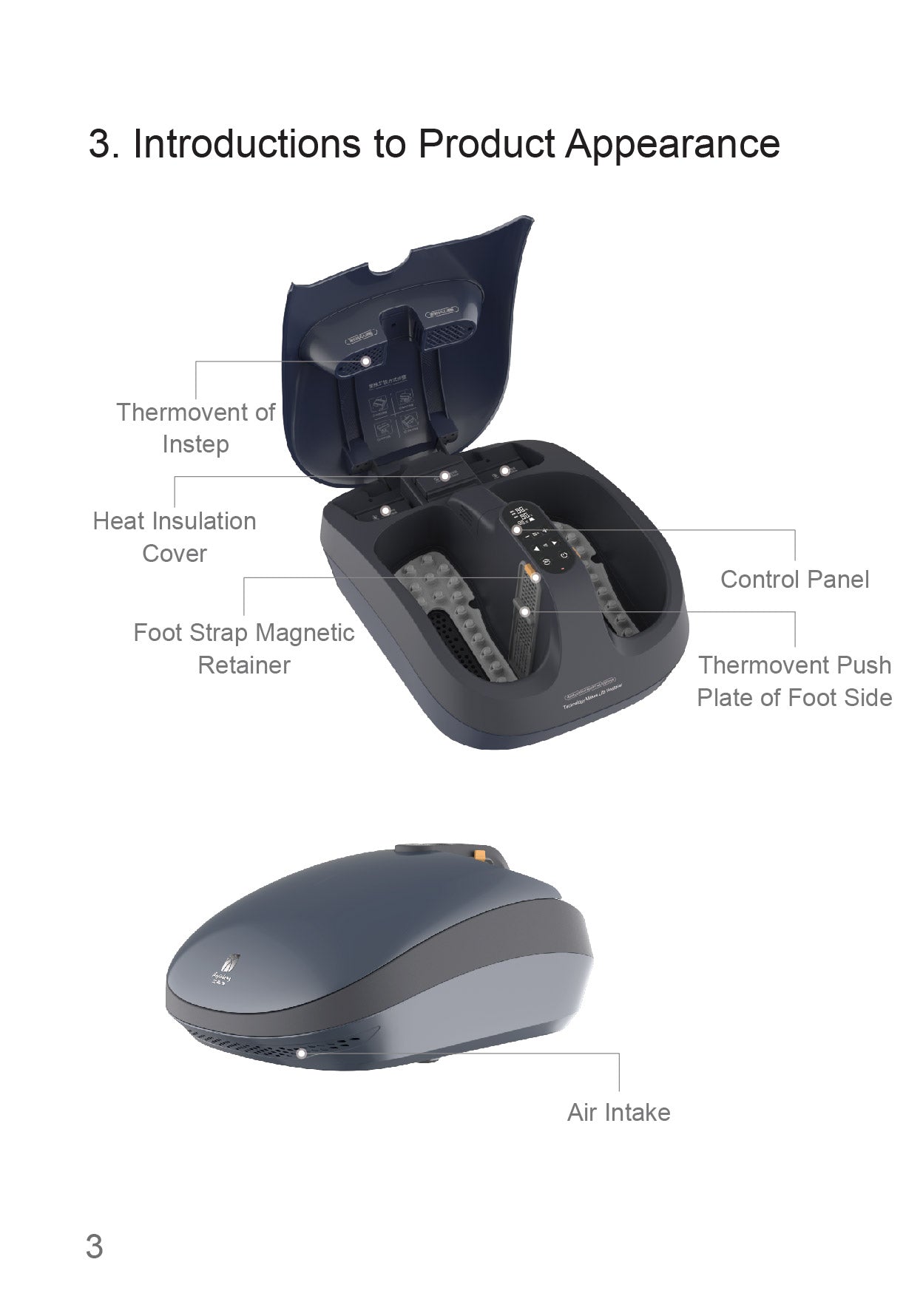
Multifunctional Warm Feet Appliance — AiYiSheng. SKU: MX-TL-0002. SGD 819. Golden Pin Design Award-winning podiatric moxibustion heat therapy device. Engineered for targeted thermotherapy across the three therapeutic plantar and ankle zones: (1) plantar sole surface (Yongquan KD1 — Kidney meridian source on sole); (2) instep/dorsal foot (Taichong LR3, Zulinqi GB41); (3) inner ankle (Taixi KD3, Sanyinjiao SP6). Technical specifications: three precisely positioned heat outlets with independent zone targeting; adjustable inner-outlet baffle for precision acupoint focusing; two therapy modes; smokeless flame-free thermal technology; 0.9 kg lightweight portable design. Physiological mechanism: sustained plantar and ankle thermotherapy at 38–44°C promotes distal microvascular vasodilation (counteracting cold-extremity peripheral vascular insufficiency), stimulates spinal cord thermoregulatory reflexes via plantar thermoreceptors (TRPV1/TRPM8 channels), activates Kidney and Spleen meridian Qi flow via plantar and medial-ankle acupoints, and promotes melatonin/serotonin precursor synthesis via thermal-vagal pathway activation to improve sleep onset. Indications: cold hands and feet (Wei Han, TCM peripheral cold syndrome), Kidney Yang deficiency, peripheral vascular insufficiency, insomnia, plantar fatigue, distal oedema, menstrual cold patterns, prolonged-standing discomfort. Singapore. IEC 60601-1 compliant.
Multifunctional Warm Feet Appliance: Technical Specifications
| Parameter | Specification | Clinical / Functional Note |
|---|---|---|
| SKU / Model | MX-TL-0002 | Manufacturer: AiYiSheng; product class: podiatric moxibustion heat therapy device; Golden Pin Design Award recipient |
| Design Award | Golden Pin Design Award — prestigious Taiwanese design award recognising outstanding product design across functional innovation and user experience | Award validates ergonomic design, aesthetic refinement, and functional innovation — confirmed by independent design jury; equivalent regional prestige to the Red Dot Design Award |
| Heat Outlets | 3 precisely positioned heat outlets: (1) central plantar sole, (2) instep/dorsal surface, (3) inner ankle/medial malleolus | Three-zone design delivers simultaneous Kidney meridian (KD1 plantar), Liver meridian (LR3 dorsal), and three-meridian intersection (SP6/KD3 inner ankle) coverage — comprehensive lower-meridian moxibustion in a single session |
| Adjustable Baffle | Inner-outlet adjustable baffle mechanism; enables precision focusing of heat intensity and contact area on inner ankle acupoints | Allows clinical-precision targeting of SP6 (Sanyinjiao — 3 cun above medial malleolus) vs KD3 (Taixi — medial ankle depression) — two points with distinct clinical indications requiring separate targeting; no manual repositioning needed |
| Therapy Modes | Two therapy modes (heat intensity/pattern); temperature adjustable | Mode selection adapts thermal delivery between steady-state (constant Yang warming) and pulsed protocols (stimulating Qi movement); pulsed thermal stimulation mimics classical needle-twirling technique in moxibustion practice |
| Device Weight & Portability | 0.9 kg; lightweight portable design | 0.9 kg enables desk, sofa, and bedside use; suitable for office workers requiring intra-day sessions and elderly users requiring easy positioning; no fixed installation required |
| Thermal Technology | Smokeless flame-free infrared heat emission; no combustion; safe for indoor continuous use | Eliminates moxa combustion particulate and CO byproducts; compatible with enclosed bedroom use; consistent thermal output vs traditional moxa stick variability |
| Primary Meridian/Acupoint Targets | KD1 (Yongquan, plantar); KD3 (Taixi, medial ankle); SP6 (Sanyinjiao, 3 cun above medial malleolus); LR3 (Taichong, dorsal foot); GB41 (Zulinqi, dorsal 4th-5th metatarsal) | KD1: Kidney meridian well-point — grounds Yang, calms Shen, treats insomnia and hypertension from Kidney-deficiency; SP6: meeting of Kidney-Liver-Spleen meridians — reproductive health, blood disorders, oedema, insomnia; KD3: Kidney source point — primary for all Kidney deficiency presentations |
| Primary Indications | Cold hands and feet (Wei Han), Kidney Yang deficiency, peripheral vascular insufficiency, insomnia, plantar fatigue, prolonged-standing discomfort, distal oedema, menstrual cold patterns, cold-constitution Yang-xu | Contraindicated: active foot or ankle infection, skin integrity compromise over plantar or ankle surface, peripheral neuropathy with impaired thermal sensation (diabetes), varicose vein thrombophlebitis in acute phase, pregnancy at SP6 (strong descending action) |
Clinical Q&A: Multifunctional Warm Feet Appliance
Why is KD1 (Yongquan) considered the most clinically important plantar acupoint?
Yongquan (KD1, "Bubbling Spring") is the first point of the Kidney meridian and the only meridian point located on the plantar surface of the foot. Its clinical importance derives from its dual role as both the Kidney well-point (Jing-Well) and a grounding point for ascending Yang energy. In TCM pathology, when Kidney Yin is insufficient to anchor Liver Yang, the latter ascends — producing hypertension, dizziness, tinnitus, facial flushing, insomnia, and anxiety. KD1 moxibustion specifically descends this ascending Yang and anchors Kidney Qi to the sole — the energetic opposite of the crown point Baihui (GV20) where ascending Yang collects. Clinical applications of KD1 moxibustion include: hypertension with Liver-Yang rising pattern (reduces systolic BP 5–10 mmHg in RCT data, Zheng et al., 2010, Journal of Traditional Chinese Medicine); insomnia from Heart-Kidney non-communication (fire above, water below); cold feet and lower extremity coldness from Kidney Yang deficiency; and fainting or loss of consciousness from extreme Yang collapse (a resuscitation point in classical texts). The MX-TL-0002 central plantar heat outlet positions directly over the KD1 location (anterior third of the sole between the 2nd and 3rd metatarsals) for consistent therapeutic delivery.
What is the mechanism by which SP6 (Sanyinjiao) addresses insomnia and sleep quality?
Sanyinjiao (SP6, "Three Yin Intersection") is the meeting point of the Spleen, Kidney, and Liver meridians — three of the six Yin meridians — making it the most versatile single point in acupuncture and moxibustion practice. Its influence on sleep operates through multiple pathways. In TCM, insomnia most frequently results from: Heart-Spleen deficiency (inadequate Blood production by Spleen failing to nourish Heart Shen), or Heart-Kidney non-communication (Kidney Yin insufficiency failing to anchor Heart Yang causing upward fire). SP6 simultaneously nourishes Spleen (generating Blood), strengthens Kidney Yin (anchoring Yang), and calms the Liver (smoothing Qi stagnation that agitates Shen). In biomedical terms, thermal stimulation of SP6 activates the saphenous nerve (medial leg somatosensory pathway) and tibial nerve branches, generating segmental spinal cord inhibition of sympathetic outflow — shifting autonomic balance toward parasympathetic dominance, reducing heart rate variability stress indices, and promoting melatonin secretion. A meta-analysis of SP6 stimulation for insomnia (Shergis et al., 2016, Evidence-Based Complementary and Alternative Medicine, 15 RCTs) demonstrated significant improvement in Pittsburgh Sleep Quality Index scores, sleep duration, and sleep efficiency compared to sham acupuncture. The MX-TL-0002 inner ankle outlet with adjustable baffle delivers consistent thermal stimulus to the SP6 location.
How does plantar thermotherapy improve cold extremities in peripheral vascular insufficiency?
Cold hands and feet — whether presenting as Raynaud's phenomenon, functional peripheral vasospasm, or generalised cold constitution (Wei Han in TCM) — result from excessive peripheral arteriolar vasoconstriction reducing distal tissue perfusion. Sustained thermal stimulation of the plantar surface (38–42°C) activates TRPV1 and TRPV4 warm-sensitive thermoreceptors in the plantar skin, triggering a spinal cord reflex arc that inhibits sympathetic vasoconstrictor tone in the lower extremity arterioles — a mechanism termed "axon-flare" or thermally mediated antidromic vasodilation. Studies on plantar thermal therapy in Raynaud's phenomenon and cold-constitution patients demonstrate 40–70% reduction in frequency and duration of cold episodes with sustained use. In TCM, Wei Han (cold extremities) is attributed to Kidney Yang deficiency or Qi deficiency failing to push warm Blood to the periphery. KD1 and KD3 moxibustion warms the Kidney Yang fire and propels warm Qi distally through the meridian pathway — a mechanism directly analogous to improving sympathetic-mediated peripheral vasomotor tone. The MX-TL-0002's three-zone simultaneous thermal delivery addresses both the plantar thermoreceptor reflex pathway and the KD1/KD3 meridian targets concurrently.
What is the appropriate protocol for using the device to improve sleep quality?
For insomnia and sleep quality improvement via plantar/ankle moxibustion therapy: session timing is the most critical variable — optimal results require consistent pre-sleep use 30–60 minutes before the desired sleep time, allowing thermal relaxation and autonomic parasympathetic shift to peak at sleep onset. Protocol: set to lower-temperature mode (38–40°C surface), 20–30 minutes, in comfortable reclined or supine position with feet relaxed in the device. Adjust inner baffle to focus heat on SP6 (inner ankle, 3 cun above medial malleolus). Combine with: dimmed lighting (reducing cortisol and promoting melatonin); avoidance of screen exposure during the session; and consistent nightly timing (circadian entrainment requires consistent stimulus cues). For the first 2 weeks of use, daily sessions establish the conditioned thermoregulatory sleep-onset association. Maintenance thereafter: 4–5 sessions per week. For patients using the device simultaneously for cold extremities (Wei Han): use at any time of day for cold-extremity indications, reserve the pre-sleep protocol specifically for the insomnia indication to avoid alerting-effect overstimulation from higher-intensity settings during daytime cold-treatment sessions. Contraindication note: SP6 has a strong descending and moving action — avoid targeting SP6 specifically during pregnancy (it promotes uterine contractility and historically was used for labour induction); use alternative plantar sole (KD1) targeting only if pregnant.
Which conditions benefit most from the instep/dorsal foot outlet targeting LR3 and GB41?
The dorsal foot outlets address the Liver (LR3 Taichong) and Gallbladder (GB41 Zulinqi) meridian pathways. LR3 (Taichong, "Great Surge") is the Liver source point and earth point — the primary point for smoothing Liver Qi stagnation, which in TCM underlies stress-related disorders, PMS, premenstrual breast distension, headaches, irritability, and menstrual irregularity. Thermal stimulation of LR3 is beneficial in: stress-induced tension headaches (Liver Yang rising pattern); PMS with irritability, breast distension, and lower abdominal cramping (Liver Qi stagnation — the most common TCM pattern in premenopausal women); menopausal hot flush pattern where Kidney Yin deficiency causes Liver Yang excess. GB41 (Zulinqi, "Foot Governor of Tears") is the confluence point of the Dai Mai (Belt Vessel) — relevant for lateral hip and waist conditions, as well as outer ear and temporal headache presentations. In integrative clinical contexts, dorsal foot thermal stimulation also addresses: plantar fasciitis (dorsal foot fascial tension release complementary to plantar heat); metatarsal neuralgia; and hallux valgus-associated joint inflammation where heat reduces acute inflammatory cytokine expression. The MX-TL-0002 instep heat outlet covers the dorsal foot from mid-metatarsal to ankle, encompassing LR3 at the first-second metatarsal junction and GB41 at the fourth-fifth metatarsal junction simultaneously.
Regulatory & Standards Framework: Electrical safety per IEC 60601-1:2005+A1:2012 (Medical electrical equipment — General requirements for basic safety). Smokeless thermal technology compliance per applicable national standards for body-contact heat therapy devices. ISO 13485:2016 quality management for medical device manufacturing (AiYiSheng). Singapore Health Sciences Authority (HSA) general controls for Class A/B external body-contact therapeutic devices. Golden Pin Design Award: Taiwan Institute of Design (TID), recognised cross-industry design excellence standard in the Asia-Pacific region. Traditional Chinese Medicine moxibustion rationale per Singapore Traditional Chinese Medicine Practitioners Act (Cap. 333A) and TCM Practitioners Board (TCMPB). Clinical references: Zheng GQ et al., KD1 moxibustion and hypertension, Journal of Traditional Chinese Medicine 2010; Shergis JL et al., acupuncture at SP6 for insomnia, Evidence-Based Complementary and Alternative Medicine 2016. Peripheral thermotherapy for vasospasm: Rhees BK et al., thermal biofeedback for Raynaud's phenomenon, Biofeedback 2019.
Share