Coloplast
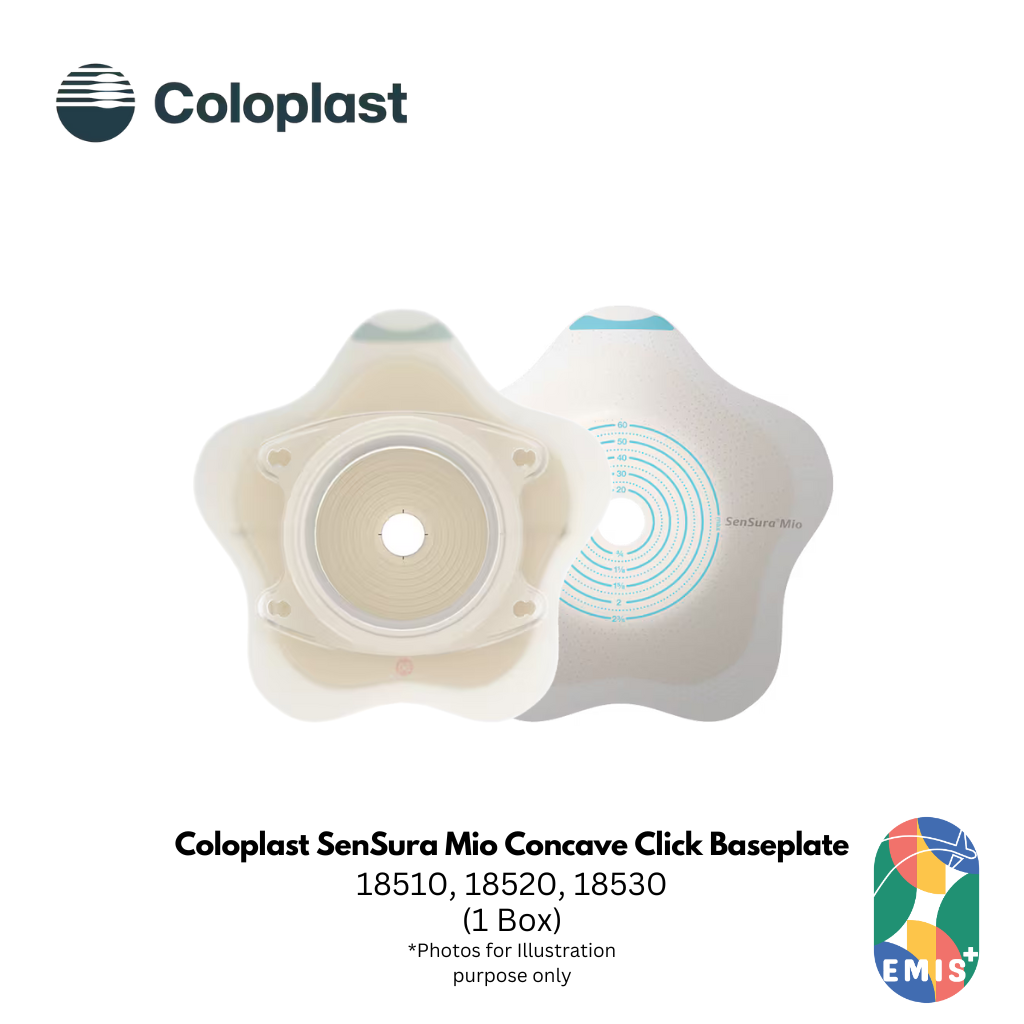
Coloplast SenSura Mio Concave Click Baseplate – Curved Star Shaped Design for Hernias, Bulges & Curves | Models 18510, 18520, 18530
无法加载取货服务可用情况
Product Overview
The Coloplast SenSura Mio Concave Click Baseplate (Models 18510, 18520, 18530) addresses one of the most challenging clinical scenarios in ostomy care: maintaining a reliable seal on peristomal surfaces affected by parastomal hernias, body contours, creases, and irregular topography. The baseplate's proprietary concave star-shaped geometry is designed to flex into body curves and around bulges rather than bridging over them, which would create gaps and increase the risk of leakage and peristomal skin complications.
The elastic adhesive technology allows the baseplate to stretch and conform to dynamic body movements — sitting, bending, and twisting — while maintaining continuous contact with the peristomal skin. Integrated flexlines within the baseplate provide structural stability immediately around the stoma opening (preventing undermining and leakage) while permitting the outer edges to flex independently with body movement. The neutral-grey textile backing provides discretion under clothing. The Click coupling mechanism delivers an audible confirmation when the pouch is securely attached, providing reassurance against accidental disconnection. Manufactured by Coloplast A/S, Denmark under ISO 13485 quality management.
Specifications
| Manufacturer | Coloplast A/S, Denmark |
| Product References | 18510 (50mm coupling, 10–45mm cut-to-fit); 18520 (60mm coupling, 10–55mm cut-to-fit); 18530 (70mm coupling, 10–65mm cut-to-fit) |
| System | Two-piece Click coupling (mechanical audible lock) |
| Baseplate Shape | Concave star-shaped with integrated flexlines |
| Adhesive Type | Elastic adhesive — stretches with body movement |
| Stoma Opening | Cut-to-fit for custom sizing |
| Convexity | Concave (designed for bulges and hernias) |
| Belt Tabs | Integrated belt tabs for optional belt support |
| Inspection Window | Yes — allows visual inspection of stoma and peristomal skin |
| Filter | Full circle integrated filter (on compatible pouches) |
| Latex Content | Not made with natural rubber latex |
| Sterility | Non-sterile; individually packaged |
| Regulatory | CE Marked (EU MDR 2017/745 Class IIa); ISO 13485 Quality Management; FDA 510(k) cleared; HSA Singapore registered |
| Packaging | Box of 5 baseplates |
Clinical Indications
- Peristomal management in patients with parastomal hernias where conventional flat baseplates cannot maintain adequate seal integrity
- Stoma care for patients with significant body contours, abdominal creases, or skin folds in the peristomal area
- Two-piece ostomy management for colostomy, ileostomy, and urostomy patients requiring a concave baseplate profile
- Patients transitioning from one-piece systems who require improved leak prevention on irregular peristomal surfaces
- Active patients requiring a baseplate that accommodates dynamic body movements without seal compromise
- Postoperative stoma patients developing early parastomal hernia or peristomal skin complications due to poor appliance fit
Frequently Asked Questions
Q: How does the concave design differ from flat and convex baseplates?
A: Flat baseplates are designed for relatively even peristomal surfaces. Convex baseplates apply pressure to help flush or retracted stomas protrude. The concave star-shaped design addresses the opposite problem: it flexes around and into outward bulges, hernias, and body curves that would lift a flat baseplate away from the skin. The star-shaped geometry allows each arm of the baseplate to independently conform to the peristomal topography, as recommended by the World Council of Enterostomal Therapists (WCET) guidelines for parastomal hernia management.
Q: How do I select the correct coupling size (18510, 18520, or 18530)?
A: Coupling size is determined by stoma diameter. Measure the stoma at its widest point and select the baseplate that allows a cut-to-fit opening 1–2 mm larger than the measured stoma size. Model 18510 (50mm coupling) accommodates stomas up to 45mm; 18520 (60mm coupling) up to 55mm; and 18530 (70mm coupling) up to 65mm. The corresponding SenSura Mio Click pouch must match the coupling colour code (yellow for 50mm, red for 60mm, green for 70mm). Stomal Therapy Nurses can assist with sizing assessment.
Q: Can this baseplate be used with a support belt?
A: Yes. All three models feature integrated belt tabs compatible with the Coloplast SenSura Mio elastic belt. Belt support is often recommended for patients with parastomal hernias to provide additional mechanical security and reduce the risk of appliance displacement during physical activity, consistent with British Colostomy Association and ASCN UK guidelines.
Q: Is the SenSura Mio Concave baseplate available in Singapore?
A: Yes. Coloplast SenSura Mio Concave Click Baseplates (18510, 18520, 18530) are available through EMIS (Essential Medical International Supplies Pte Ltd) in Singapore. The products are HSA-registered medical devices. Healthcare facilities, stoma care clinics, and individual patients can order through emis.asia with delivery across Singapore.
Q: How long can the baseplate be worn before changing?
A: Wear time depends on individual factors including stoma output consistency, peristomal skin condition, physical activity level, and climate. Most patients achieve 3 to 5 days of wear time. The elastic adhesive is designed to maintain adhesion through multiple pouch changes in the two-piece system. Change the baseplate when adhesion begins to diminish, if leakage occurs, or if peristomal skin irritation is observed. Regular assessment by a Stomal Therapy Nurse is recommended per Coloplast Ostomy Care clinical guidelines.
分享