SkinCeuticals
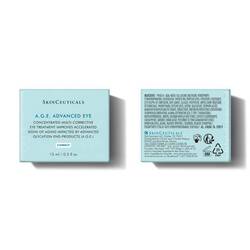
SkinCeuticals A.G.E. Advanced Complex Anti Wrinkle Eye Cream
SkinCeuticals A.G.E. Advanced Complex Anti Wrinkle Eye Cream
无法加载取货服务可用情况
Product Overview
The SkinCeuticals A.G.E. Advanced Complex Anti-Wrinkle Eye Cream addresses the specific dermocosmetic challenges of the periorbital region: an epidermal thickness of approximately 0.5 mm (versus 2 mm on other facial zones), limited sebaceous gland density, and high repetitive mechanical stress from blinking (15,000–20,000 involuntary blinks daily). These anatomical features accelerate visible aging through collagen degradation, dermal thinning, and AGE-mediated cross-linking of residual structural proteins. Proxylane™, a patented xylose derivative synthesised from wood hemicellulose, acts as a substrate for proteoglycan and hyaluronic acid biosynthesis in periorbital fibroblasts, restoring dermal plumpness and reducing the appearance of fine lines within 8–12 weeks of consistent daily use.
Blueberry-derived anthocyanins competitively inhibit the Maillard reaction in the periorbital dermis, blocking the irreversible sugar-protein cross-linking that renders collagen fibres rigid and discoloured (contributing to dark circle appearance in fair-skinned patients). Bisabolol (α-bisabolol, chamomile-derived) provides anti-inflammatory modulation appropriate for the vascular and sensitive periorbital tissue. The formulation is free of fragrance and is formulated for minimal sting-on-application to sensitised orbital skin. This eye cream is manufactured under ISO 22716:2007 Cosmetics GMP and has undergone ophthalmologist-reviewed tolerability testing.
Product Specifications
| Parameter | Details |
|---|---|
| Manufacturer | SkinCeuticals (L'Oréal Group, USA) |
| Product Name | A.G.E. Advanced Complex Anti-Wrinkle Eye Cream |
| Volume | 15 mL |
| Form | Eye cream (smooth, fast-absorbing emulsion) |
| Key Actives | Proxylane™ (xylose derivative), Blueberry Extract (anthocyanin complex), Bisabolol (α-bisabolol) |
| Primary Mechanism | AGE formation inhibition; periorbital glycosaminoglycan & collagen synthesis; anti-inflammatory barrier support |
| Indicated Skin Types | All Fitzpatrick skin types (I–VI); suitable for sensitive and mature periorbital skin |
| Application Site | Periorbital region (orbital rim, crow's feet, upper lid); avoid direct mucous membrane contact |
| Usage Frequency | Twice daily (AM and PM) |
| Fragrance | Fragrance-free |
| Regulatory – Singapore | Cosmetic product; subject to mandatory notification via HSA PRISM portal under Health Products (Cosmetic Products) Regulations; all ingredients within HSA permitted lists |
| Regulatory – EU | Compliant with EU Cosmetics Regulation (EC) No 1223/2009; ingredients within permitted Annexes |
| Manufacturing Standard | ISO 22716:2007 (Cosmetics GMP) |
| Ophthalmological Testing | Ophthalmologist-reviewed; suitable for contact lens wearers (allow lens to settle before application) |
| Preservative Efficacy | Tested per ISO 11930 |
| Retail Price (Singapore) | SGD $185 per 15 mL |
Clinical Indications and Key Applications
- Periorbital AGE-mediated fine lines (crow's feet): Daily corrective use indicated for patients with lateral canthal fine lines (crow's feet) driven by collagen glycosylation, particularly in those aged 35–65 with visible dermal thinning in the temporal orbital region.
- Loss of periorbital firmness and elasticity: Proxylane™-stimulated glycosaminoglycan synthesis restores periorbital dermal hydration and viscoelastic recoil, addressing laxity around the upper and lower orbital rim.
- Glycation-associated dark circles: In Fitzpatrick type I–III patients, AGE-mediated collagen discolouration contributes to a grey-brown dark circle appearance; anthocyanin anti-glycation activity addresses this mechanism in addition to vascular and pigment-based causes.
- Post-procedure periorbital care: Bisabolol anti-inflammatory activity and phytosphingosine-class barrier support in the formulation make it suitable as a post-treatment adjunct following non-ablative periorbital laser toning, radiofrequency, or microneedling in clinical aesthetic protocols.
- Combination AGE-interruption protocol: Use in conjunction with SkinCeuticals A.G.E. Interrupter Advanced (for face/neck/décolletage) provides comprehensive AGE-targeted coverage for patients undergoing full-face corrective anti-aging regimens in aesthetic medicine practice.
- Contact lens wearers and sensitive orbital skin: Ophthalmologist-reviewed formulation with fragrance-free, low-sting profile makes this eye cream appropriate for patients with chronic blepharitis, dry eye syndrome, or known sensitisation to fragranced periorbital products.
Frequently Asked Questions
Q: How does A.G.E. Advanced Complex differ from hydrating eye creams or retinol-based eye treatments?
A: Standard hydrating eye creams address moisture barrier function and immediate TEWL reduction without altering the underlying AGE-mediated degradation of periorbital collagen. Retinol-based eye treatments activate retinoic acid receptor (RAR) pathways for epidermal renewal and type I collagen upregulation, but may cause barrier perturbation in sensitive periorbital skin, particularly at concentrations above 0.05%. A.G.E. Advanced Complex addresses a mechanistically distinct and complementary pathway—non-enzymatic glycosylation inhibition via anthocyanin competition at glycation sites—alongside Proxylane™-driven glycosaminoglycan synthesis, providing corrective activity without the retinol-associated risk of periorbital irritation or ectropion exacerbation.
Q: What is the recommended application technique to maximise periorbital absorption?
A: Dispense one drop per eye (approximately 0.1–0.15 mL) onto the ring finger. Apply by gentle tapping along the orbital bone margin—not directly on the eyelid skin—working from the inner to outer canthal area. The ring finger exerts less pressure than the index finger (typically 40–60% less force), reducing mechanical disruption to the fragile periorbital dermal-epidermal junction. Allow 60–90 seconds for absorption before applying SPF (AM) or additional serum layers (PM). In Singapore's humid climate, allow the eye cream to set completely before eye makeup application to prevent migrating product.
Q: Is A.G.E. Advanced Complex suitable for patients with periorbital hyperpigmentation common in Asian skin types?
A: Periorbital hyperpigmentation in darker Fitzpatrick types (IV–VI) is predominantly post-inflammatory, vascular, or constitutive melanin-related rather than solely AGE-driven. A.G.E. Advanced Complex addresses the glycation component specifically; for comprehensive pigment management in Asian patients, co-formulation with a tyrosinase inhibitor (e.g., niacinamide, tranexamic acid) may be clinically indicated. That said, the anthocyanin antioxidant load reduces secondary oxidative pigment formation, providing a complementary benefit. Patients should be counselled that results for hyperpigmentation are secondary and gradual (12–16 weeks), whereas firmness and fine line outcomes manifest at 8–12 weeks.
Q: What are the Singapore HSA regulatory requirements for stocking SkinCeuticals products in a clinic or aesthetic practice?
A: Under the Singapore Health Products Act (Cap. 122D) and Health Products (Cosmetic Products) Regulations, cosmetic products must be notified (not registered) with HSA prior to market supply. The notifying party (typically the authorised distributor or importer) submits product details via the PRISM portal, confirming ingredient compliance with the negative list of prohibited/restricted substances. Aesthetic clinics and dermatology practices procuring for resale must source from an authorised HSA-notified distributor. SkinCeuticals products in Singapore are distributed through authorised professional channels; clinics should request the HSA notification reference number from the distributor prior to stocking.
Q: How should A.G.E. Advanced Complex be stored and what is the shelf life?
A: Store at room temperature (15–25°C), away from direct sunlight and humidity. Singapore's tropical climate (ambient temperature typically 26–32°C) necessitates storage in air-conditioned spaces; avoid leaving product in vehicles or near windows. Opened product is typically stable for 12 months post-opening (indicated by the Period After Opening — PAO — symbol on packaging). Discard if colour, texture, or odour changes are observed. For clinic-setting dispensing, the product should remain in the original sealed packaging until dispensed to the patient.
分享