Amili
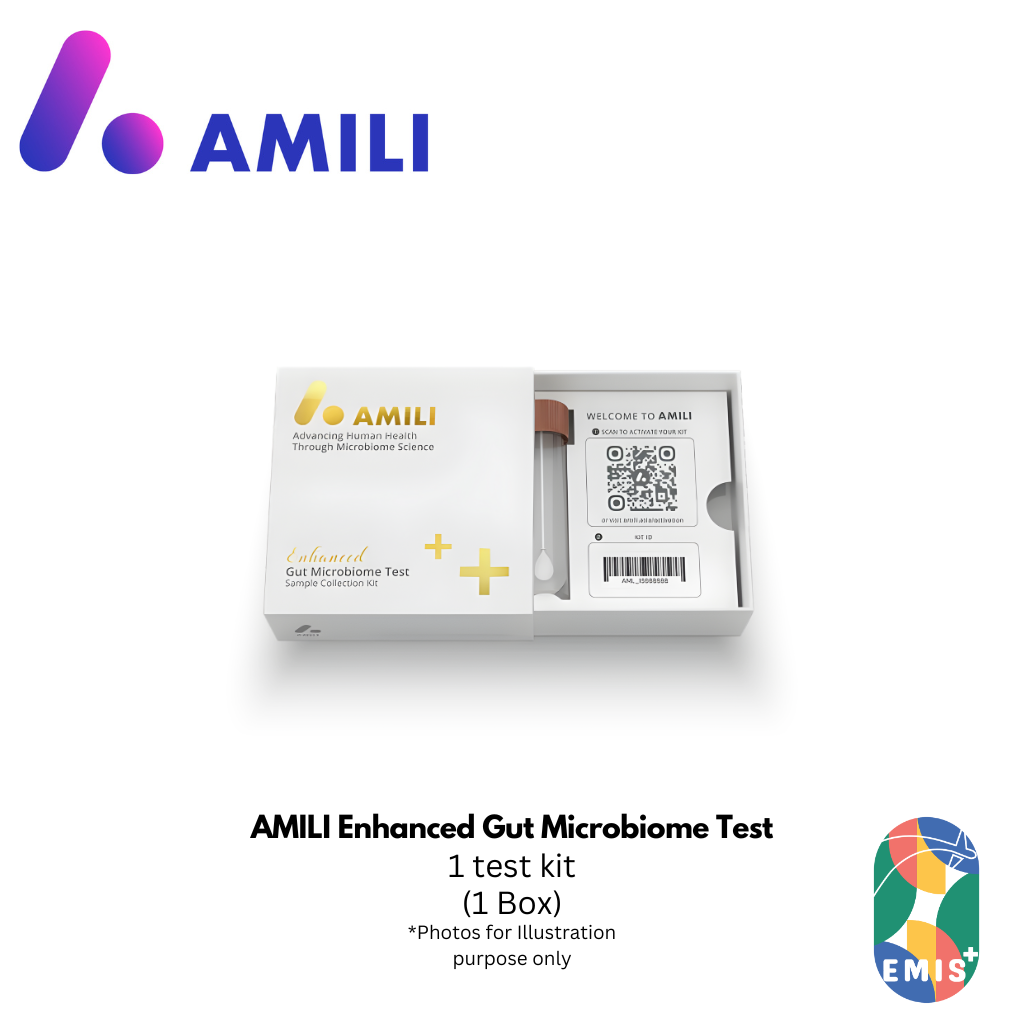
AMILI Enhanced Gut Microbiome Test
AMILI Enhanced Gut Microbiome Test
无法加载取货服务可用情况
Product Overview
The AMILI Enhanced Gut Microbiome Test is a precision-medicine diagnostic developed by AMILI Pte Ltd, a Singapore-headquartered microbiome biotechnology company spun out from the Singapore Stool Bank. It applies next-generation 16S rRNA gene amplicon sequencing to a single self-collected stool specimen to enumerate the relative abundance of bacterial taxa colonising the lower gastrointestinal tract. Unlike Western-derived microbiome panels, AMILI benchmarks each sample against GUTOMICS™, a proprietary database of more than 10,000 multi-ethnic Asian gut microbiomes curated in collaboration with A*STAR and regional clinical partners.
The Enhanced report quantifies four core functional axes derived from peer-reviewed metagenomic literature: Digestive Health (short-chain fatty acid producers, fibre fermenters), Immunity & Inflammation (regulatory taxa, opportunistic pathogen markers), Metabolic Health (bile acid metabolism, glucose homeostasis indicators), and Brain Health (gut-brain axis modulators including serotonin precursors). Each parameter is contextualised against age-, sex-, and ethnicity-matched cohorts. The clinician version of the report provides actionable dietary fibre prescriptions, prebiotic targets, and a personalised AMILI probiotic strain recommendation calibrated to the patient's deficiency profile.
Technical Specifications
| Manufacturer | AMILI Pte Ltd, Singapore |
|---|---|
| Test Type | At-home stool collection, laboratory-processed gut microbiome profiling |
| Sequencing Platform | 16S rRNA gene amplicon sequencing (V3-V4 region) on Illumina platform |
| Reference Database | GUTOMICS™ multi-ethnic Asian gut microbiome reference (>10,000 samples) |
| Functional Axes Reported | Digestion, Immunity & Metabolism, Brain Health, Probiotic Match |
| Sample Type | Single stool specimen, stabilised in proprietary preservative buffer |
| Collection Method | Self-collection at home using supplied kit; courier or drop-off return |
| Sample Stability | Up to 14 days at ambient temperature once stabilised |
| Turnaround Time | 4-5 weeks from laboratory receipt to digital report |
| Eligible Age | 5 years and above (gut microbiome maturation threshold) |
| Quality System | ISO 15189-aligned laboratory workflow; ISO 13485 quality management |
| Regulatory | HSA Singapore notified; CLIA-equivalent laboratory standards; data handling per Singapore PDPA |
| Report Format | Digital PDF (patient and clinician versions) with personalised recommendations |
Clinical Indications
- Baseline gut microbiome characterisation for patients with chronic digestive complaints (IBS, functional dyspepsia, chronic constipation, intermittent diarrhoea)
- Workup for suspected gut-immunity dysregulation (recurrent infections, atopic dermatitis, allergic rhinitis, food intolerance)
- Metabolic health profiling in pre-diabetes, dyslipidaemia, or metabolic syndrome management
- Pre- and post-intervention monitoring for dietary modification, antibiotic recovery, or targeted probiotic therapy
- Adjunct assessment in mood, sleep, and cognition concerns where the gut-brain axis is clinically relevant
- Routine wellness screening as part of an integrated functional medicine or longevity programme
Frequently Asked Questions
Why is an Asian reference database important for interpreting my results?
Gut microbiome composition is strongly shaped by diet, ethnicity, and geography. Reference ranges built from European or North American cohorts systematically misclassify Asian samples because key fibre-fermenting taxa (e.g. Prevotella copri, Faecalibacterium prausnitzii) are present at different baseline abundances. AMILI's GUTOMICS™ database, validated in peer-reviewed studies with A*STAR, allows population-appropriate interpretation that is clinically defensible for Singaporean and broader Southeast Asian patients.
Is 16S rRNA sequencing clinically reliable?
16S rRNA gene sequencing is the established methodology for genus- and family-level bacterial profiling, recommended by the Human Microbiome Project and used in over 30,000 published studies. It does not resolve to strain level (which requires whole-genome shotgun sequencing) but is appropriate, cost-effective, and reproducible for the functional reporting AMILI delivers. Laboratory workflows are aligned with ISO 15189 medical laboratory standards.
How does this differ from a stool culture or faecal calprotectin test?
Stool culture detects only a narrow range of culturable pathogens; faecal calprotectin quantifies neutrophil-derived inflammation. The AMILI Enhanced test profiles the entire bacterial community at relative-abundance level, enabling assessment of dysbiosis patterns, diversity indices (Shannon, Simpson), and functional capacity that conventional microbiology cannot reveal. It complements rather than replaces these established assays.
Is the test reimbursable under Singapore Medisave or private insurance?
The AMILI Enhanced Gut Microbiome Test is a wellness diagnostic and is generally not Medisave-claimable. Some private integrated shield plans and corporate wellness programmes (including the Manulife-AMILI partnership) provide partial reimbursement; patients should confirm coverage with their insurer and obtain a referral letter from a registered Singapore medical practitioner where required.
How should the report be acted upon clinically?
Reports are designed for review with a qualified healthcare provider, registered dietitian, or naturopath. AMILI provides clinician onboarding materials and a Singapore-based scientific advisory team. Recommendations should be integrated with full clinical history, dietary assessment, and existing pharmacotherapy; the test is not a substitute for diagnostic endoscopy, imaging, or pathogen-specific assays where indicated.
Why Buy From EMIS+
- Nurse-led Singapore medical supply store — clinical expertise you can trust.
- Authentic products with fast island-wide delivery across Singapore.
- Bulk and recurring orders for home care and nursing facilities are welcome.
- Questions about AMILI Enhanced Gut Microbiome Test? Our team is here to help via emis.asia.
Frequently Asked Questions
What is AMILI Enhanced Gut Microbiome Test used for?
AMILI Enhanced Gut Microbiome Test is a dietary supplement stocked by EMIS+, Singapore's nurse-led medical supply store. Supplements are intended to support general health and wellbeing and are not a substitute for medical treatment. Always consult your doctor or pharmacist before starting any new supplement, especially if you are pregnant, nursing, or taking medication.
How should I take AMILI Enhanced Gut Microbiome Test?
Follow the dosage instructions printed on the AMILI Enhanced Gut Microbiome Test packaging, or take as directed by your doctor or pharmacist. Do not exceed the recommended dose.
Where can I buy AMILI Enhanced Gut Microbiome Test in Singapore?
AMILI Enhanced Gut Microbiome Test is available from EMIS+ at emis.asia — a nurse-led Singapore medical supply store with fast island-wide delivery. Bulk and recurring orders are welcome. Contact us via emis.asia.
分享