Buzud
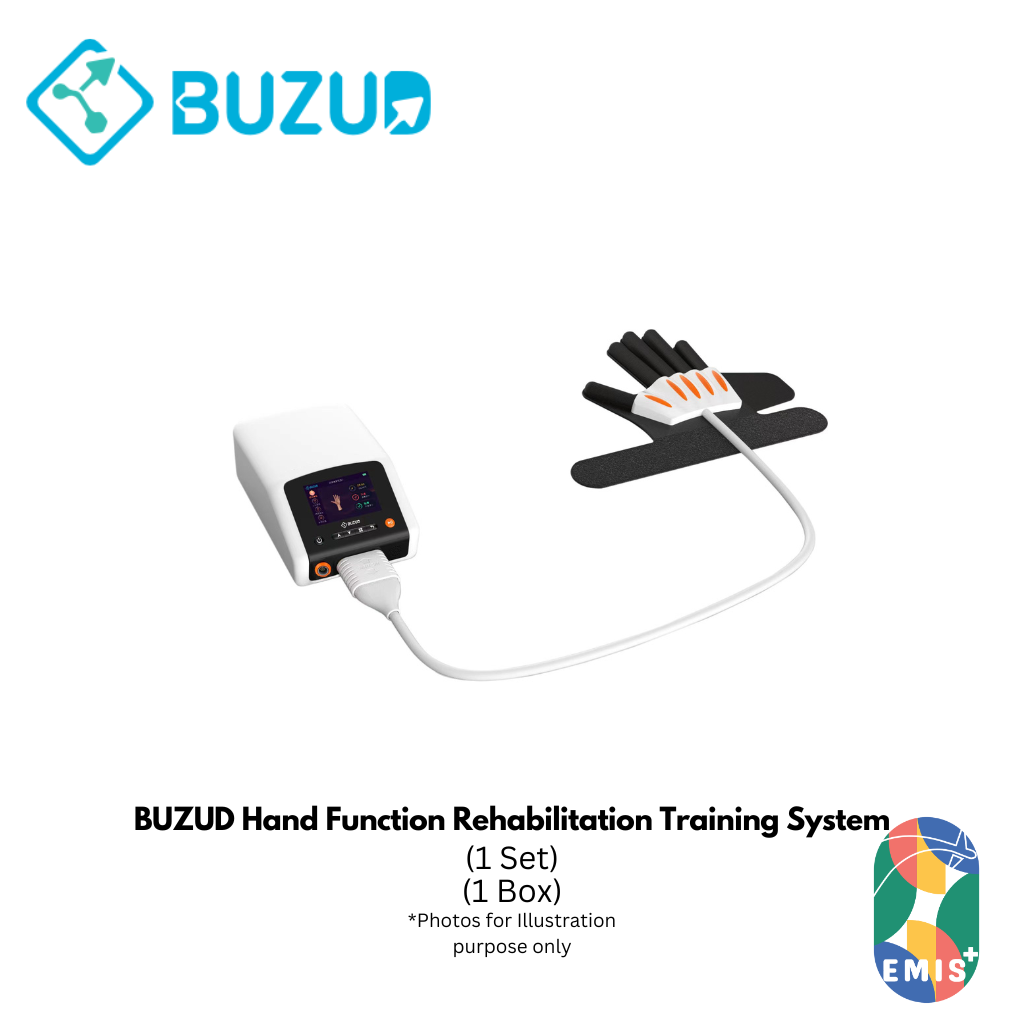
BUZUD Hand Function Rehabilitation Training System
BUZUD Hand Function Rehabilitation Training System
无法加载取货服务可用情况
A powered soft robotic glove rehabilitation system providing repetitive task-oriented hand movement therapy for adults recovering from stroke, acquired brain injury, peripheral nerve injury, or orthopaedic hand/wrist conditions. The system uses a bionic pneumatic or electromechanical glove actuator driven by a programmable control unit to deliver assisted finger flexion and extension, supporting neuroplasticity-based motor re-learning and functional hand recovery. Suitable for home, clinic, and hospital rehabilitation settings. Control host rated DC 24 V / 60 W maximum; glove weight 0.5 kg.
System Specifications
| Parameter | Value |
|---|---|
| System Type | Soft robotic powered glove rehabilitation system |
| Control Host Dimensions | 210 × 140 × 80 mm |
| Control Host Weight | 1.5 kg |
| Glove Dimensions | 250 × 180 × 30 mm |
| Glove Weight | 0.5 kg |
| Rated Charging Voltage | DC 24 V |
| Maximum Power Output | 60 W |
| Therapy Modes | Multiple programmable modes — adjustable intensity and movement pattern |
| Actuation Type | Bionic soft robotics — assists active finger flexion and extension |
| Usage Setting | Home, outpatient clinic, and inpatient rehabilitation ward |
| Intervention Type | Non-invasive, drug-free; adjunct to physiotherapy and occupational therapy programmes |
| Box Contents | Control unit, soft robotic glove, charging adapter, user manual |
| Standard Compliance | ISO 13485 (medical device quality management); IEC 60601-1 (electrical safety for medical devices) |
Clinical Indications
- Post-stroke upper limb rehabilitation — hemiparetic hand with residual volitional movement (Brunnstrom Stage 3–5); adjunct to occupational therapy
- Traumatic brain injury (TBI) — hand motor recovery during sub-acute and chronic rehabilitation phases
- Peripheral nerve injury recovery — radial, median, or ulnar nerve palsy with partial motor return
- Post-orthopaedic hand/wrist surgery — tendon repair, fracture fixation, or joint replacement requiring guided active-assisted range of motion (AAROM)
- Spasticity management — repetitive movement therapy to reduce finger flexor spasticity in neurological conditions
- Long-term home-based neurological rehabilitation where clinic attendance is limited
Community Consensus: Clinical Q&A
Q: What is the evidence base for robotic glove therapy in post-stroke hand rehabilitation?
Robotic-assisted hand rehabilitation is supported by a substantial body of evidence. A 2019 Cochrane systematic review (Mehrholz et al.) of electromechanical and robot-assisted arm training post-stroke found that repetitive task-specific robotic therapy significantly improved arm function (Fugl-Meyer upper extremity score) and activities of daily living compared to conventional therapy alone, particularly in the sub-acute phase. The therapeutic mechanism is neuroplasticity — repeated, high-volume, task-specific movement activates motor cortex reorganisation (cortical remapping) and strengthens surviving corticospinal tract projections. Robotic devices facilitate significantly higher movement repetition volumes than is achievable with manual therapy alone.
Q: Who is eligible for soft robotic glove rehabilitation — is any residual hand movement required?
Most robotic glove systems, including the BUZUD Hand Function Rehabilitation Training System, are most effective when the patient retains some volitional motor signal — typically Brunnstrom Stage 3 or above (presence of gross synergistic movement). Patients with complete flaccid paralysis (Brunnstrom Stage 1–2) have limited capacity for motor re-learning via repetitive movement and may require different interventions (e.g. neuromuscular electrical stimulation, constraint-induced movement therapy). However, passive-mode robotic glove therapy (device-driven movement without active patient participation) may still provide range-of-motion maintenance and spasticity reduction benefits in lower Brunnstrom stages. Clinical assessment by an occupational therapist or physiotherapist before commencing robotic glove therapy is recommended.
Q: How does the BUZUD system integrate with physiotherapy and occupational therapy programmes?
The BUZUD Hand Function Rehabilitation Training System is designed as an adjunct to, not a replacement for, structured physiotherapy (PT) and occupational therapy (OT) programmes. The device provides high-volume repetitive movement practice between supervised therapy sessions — particularly valuable for home use where patients can complete 30–60 minutes of robotic glove therapy daily rather than waiting for clinic appointments. OT can programme therapy goals (grip, pinch, extension patterns) and set appropriate intensity parameters. Progress should be reviewed at each PT/OT session using standardised outcome measures such as the Fugl-Meyer Assessment (FMA-UE), Box and Block Test, or Action Research Arm Test (ARAT).
Q: Is this device available for home use without clinical supervision?
Yes. The BUZUD Hand Function Rehabilitation Training System is designed for both clinical and home use. The control unit provides pre-programmed therapy modes that can be operated independently by patients or caregivers following initial training. However, EMIS and BUZUD recommend that the therapy programme and intensity settings be established under guidance of a registered physiotherapist or occupational therapist — particularly for post-stroke or post-TBI patients where inappropriate exercise parameters could exacerbate spasticity or cause joint injury. Contact EMIS for guidance on clinical support pathways available in Singapore.
分享