Buzud
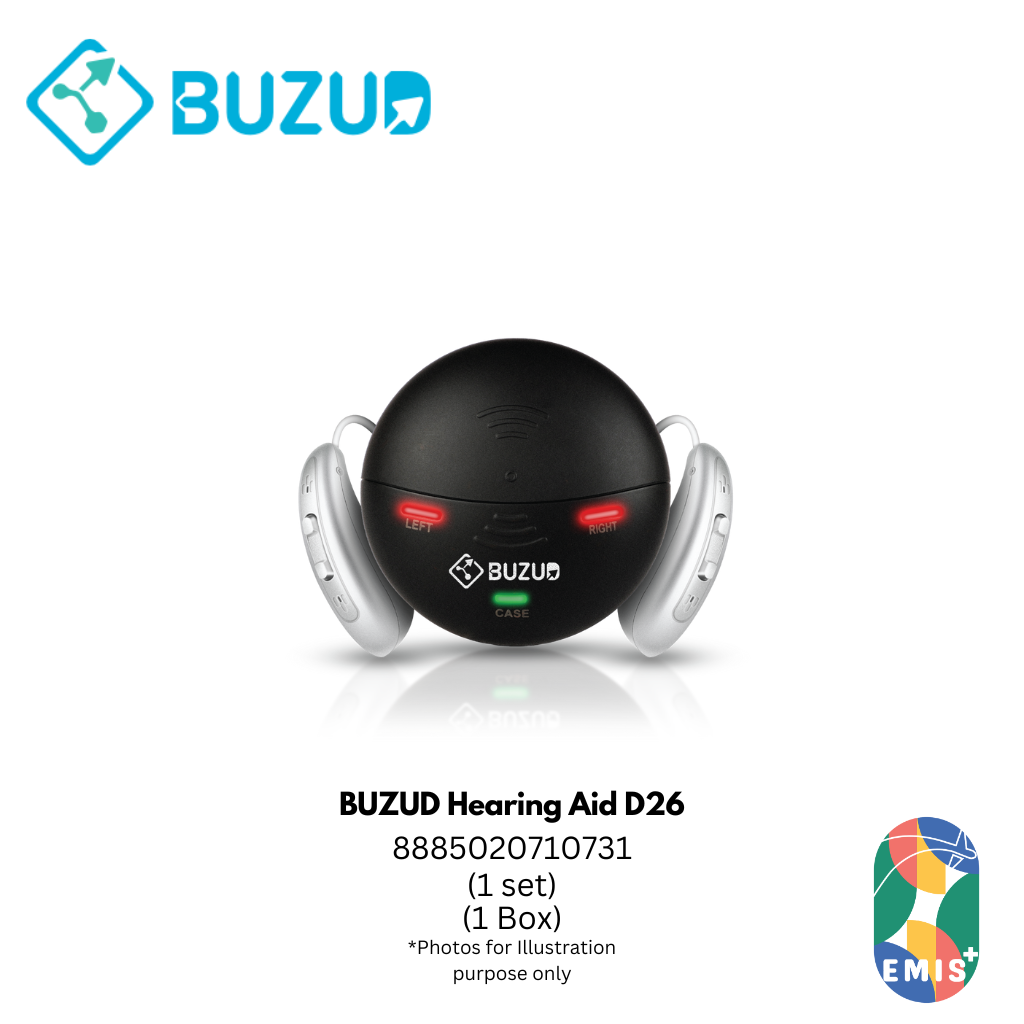
BUZUD Hearing Aid D26
BUZUD Hearing Aid D26
无法加载取货服务可用情况
A digital behind-the-ear (BTE) hearing aid indicated for mild to moderate sensorineural hearing loss in adults. Features wide dynamic range compression (WDRC), environmental noise cancellation, wind noise reduction, and a maximum OSPL90 of ≤125 dB. No Bluetooth — operates as a standalone amplification device. Supplied with a portable charging case providing up to 48 hours combined battery life. HSA Singapore approved Class B medical device. The D26 is suited to users who prioritise simplicity, extended battery life, and reliable amplification without app dependency.
Technical Specifications
| Parameter | Value |
|---|---|
| Device Type | Digital Behind-the-Ear (BTE) hearing aid |
| Indication | Mild to moderate sensorineural hearing loss |
| Frequency Range | 450 Hz – 4,500 Hz |
| OSPL90 (Max Output) | ≤125 dB ± 3 dB SPL |
| Full-On Gain (FOG) | 30 dB ± 5 dB |
| Equivalent Input Noise (EIN) | ≤29 dB ± 3 dB SPL |
| Total Harmonic Distortion (THD) | ≤4% ± 3% |
| Working Voltage | DC 3.7 V |
| Working Current | 5 mA |
| Battery Life (with case) | Up to 48 hours total |
| Connectivity | None — standalone digital device (no Bluetooth/app) |
| Signal Processing | Wide Dynamic Range Compression (WDRC); environmental noise cancellation; wind noise reduction |
| Operating Conditions | -10°C to +40°C; 30–75% RH (non-condensing) |
| Charging Case Input | DC 5.0 V / 1 A; Output: DC 4.2 V / 15 mA × 2 |
| Regulatory Approval | HSA Singapore approved — Class B medical device |
| Standard Compliance | IEC 60118-0 (hearing aid measurement); ISO 21388 (hearing aid fitting management) |
Clinical Indications
- Mild to moderate sensorineural hearing loss (PTA 26–70 dB HL at 500 Hz–4 kHz)
- Age-related hearing loss (presbycusis) — bilateral high-frequency SNHL in adults
- Users who prefer a non-app-dependent device with simple volume/programme controls
- Patients with limited smartphone proficiency or preference for traditional BTE form factor
- Noise-induced hearing loss (NIHL) — stabilised, permanent hearing loss from occupational or recreational noise
Community Consensus: Clinical Q&A
Q: How does the D26 BTE design compare to the W6 RIC design for daily wear?
The D26 uses a behind-the-ear (BTE) configuration where the processing unit sits behind the ear and delivers amplified sound through a tube and earmold or dome into the ear canal. The W6 uses a receiver-in-canal (RIC) design where the speaker is placed in the ear canal and the processor behind the ear is smaller and lighter. BTE devices like the D26 are more robust, easier to handle for users with dexterity limitations, and accommodate larger batteries — explaining the D26's 48-hour battery life advantage. RIC devices like the W6 typically provide a more natural sound quality due to the in-canal receiver placement. The best design depends on the user's dexterity, ear canal anatomy, and preference for discretion vs ease of handling.
Q: What is WDRC and why does it matter for hearing aid performance?
Wide Dynamic Range Compression (WDRC) is a signal processing algorithm that differentially amplifies soft sounds (high gain) while limiting amplification of loud sounds (low gain), compressing the dynamic range of the acoustic environment to match the residual dynamic range of the impaired ear. For a person with sensorineural hearing loss — who typically has both elevated hearing thresholds and reduced loudness tolerance (recruitment) — WDRC allows comfortable audibility of soft speech without uncomfortable loudness for sudden loud sounds. It is the standard signal processing architecture in modern digital hearing aids and is specified in IEC 60118 measurement protocols.
Q: The D26 has an EIN of ≤29 dB and THD ≤4% — are these clinically acceptable?
The D26's EIN of ≤29 dB SPL is higher than premium audiological-grade devices (15–22 dB EIN) and reflects its accessible price point. For mild hearing loss users in quiet-to-moderate ambient noise environments, this EIN is generally imperceptible above background noise. The THD of ≤4% is within the upper range of acceptable distortion for hearing aids — IEC 60118-0 specifies THD measurement conditions, and values under 5% are generally considered clinically acceptable for speech intelligibility. For users with severe speech discrimination deficits, lower THD (<1%) audiological-grade devices may provide marginal benefit.
Q: Is the D26 suitable for elderly users with limited technology experience?
Yes. The D26's absence of Bluetooth and app dependency makes it particularly suitable for elderly users who prefer or require a device with physical controls only. Operation involves volume adjustment and programme switching via on-device buttons — no smartphone pairing, app installation, or digital troubleshooting is needed. The 48-hour battery life with charging case means fewer charging events than premium RIC devices. The BTE form factor is also easier to handle for users with reduced finger dexterity. EMIS recommends initial fitting by an audiologist or trained dispenser to ensure appropriate gain settings for the individual's audiogram.
分享