Bbraun
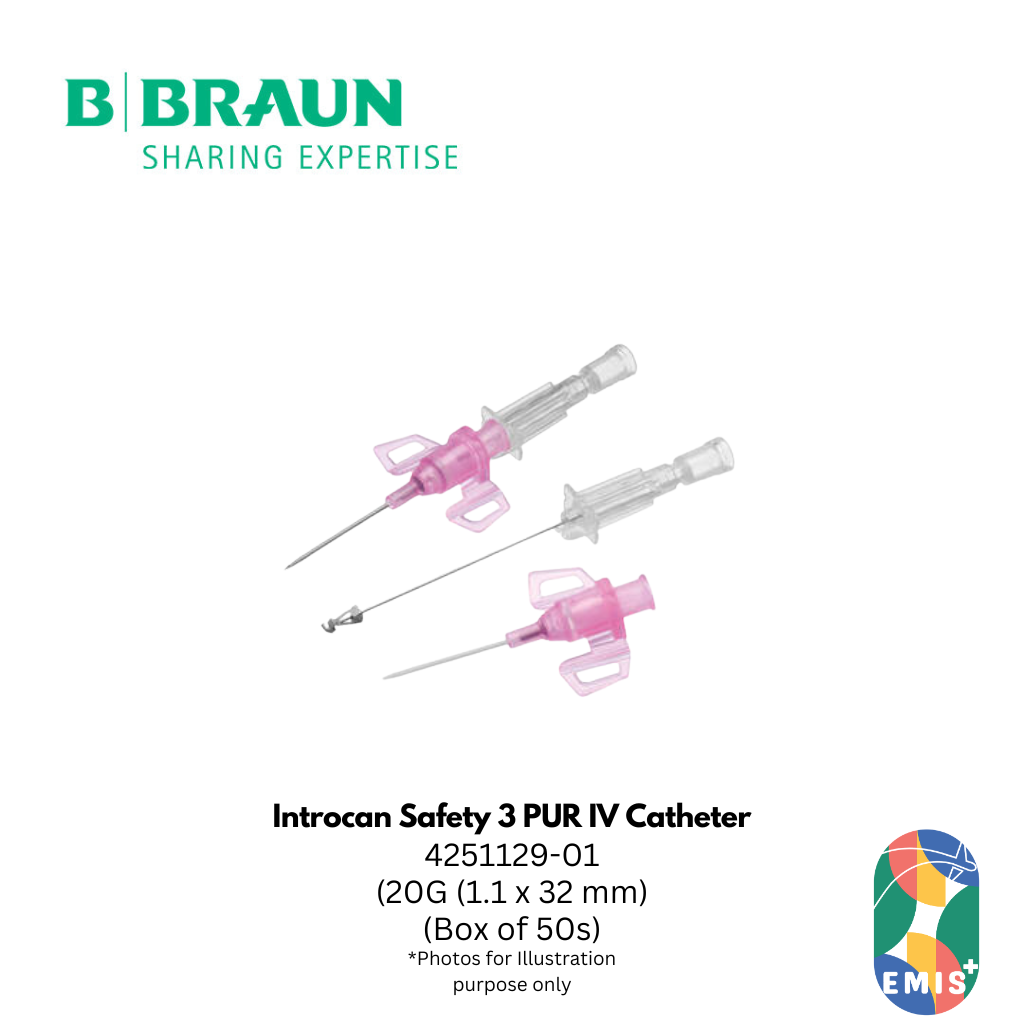
Introcan Safety 3 PUR IV Catheter 20G 1.1 x 32mm
Introcan Safety 3 PUR IV Catheter 20G 1.1 x 32mm
无法加载取货服务可用情况
A 20-gauge, 32 mm polyurethane peripheral IV catheter with passive needle-stick protection, pink ISO 10555 hub colour coding, and integrated needle guard for single-handed activation. Indicated for moderate-flow IV therapy in adults where 18G is not required — suitable for maintenance fluids, antibiotics, and blood product administration when venous access is adequate.
Product Specifications
| Parameter | Value |
|---|---|
| Gauge | 20G |
| Outer Diameter | 1.10 mm (0.043 in) |
| Catheter Length | 32 mm |
| Hub Colour (ISO 10555) | Pink |
| Max Flow Rate (water, 20°C) | ~65 mL/min |
| Catheter Material | Polyurethane (PUR) — softens at body temperature for reduced phlebitis risk |
| Needle-Stick Protection | Passive retraction with audible click — single-handed; meets EU Directive 2010/32/EU |
| Wings | Integrated safety wings — secure grip during insertion and activation |
| Sterile / Single-Use | Yes — EO sterilised, single-use only |
| Regulatory | CE marked; HSA-registered Class B medical device (Singapore) |
| Standard Compliance | ISO 10555 (intravascular catheters); ISO 15223 (device symbols) |
| Pack Quantity | 50 pieces per box |
| Latex-Free | Yes |
Clinical Indications
- IV antibiotic therapy (IVAB) — including beta-lactams, vancomycin, clindamycin
- Maintenance IV fluids — normal saline, Hartmann's, dextrose solutions
- Blood product transfusion when 18G access is unavailable or not tolerated
- Oncology IV pre-medication and supportive fluids (not primary chemotherapy port)
- Paediatric and elderly patients with smaller or fragile veins where 18G is contraindicated
- Emergency IV access in patients where larger gauge is unsuitable
Community Consensus: Clinical Q&A
Q: Can a 20G catheter support blood transfusion?
Yes. A 20G catheter (1.1 mm OD) is acceptable for blood product transfusion in most adults when a larger gauge is not available. Flow rate is lower than 18G (~65 vs ~105 mL/min), so packed red cell transfusions may take longer. For rapid transfusion or massive haemorrhage protocols, 18G or larger is preferred. The Introcan Safety 3 PUR material does not interact with blood products.
Q: How does polyurethane reduce phlebitis risk compared to FEP or PTFE?
Polyurethane (PUR) has a higher tensile strength than FEP but softens toward body temperature (~37°C), reducing catheter tip rigidity against the vein wall. This thermosoftening property is associated with lower mechanical phlebitis rates in observational studies. The Introcan Safety 3 PUR catheter is specifically designed to exploit this property for extended dwell time in peripheral veins.
Q: When should a clinician choose 20G over 18G for IV access?
20G is preferred when: (1) the patient's vein diameter cannot accommodate 18G without trauma, (2) access is needed in hand/wrist/antecubital veins with limited diameter, (3) therapies are low-volume infusions not requiring high flow rates, or (4) in paediatric adolescent patients. 18G remains first-line for blood products, contrast CT, and rapid fluid resuscitation.
Q: Does the passive safety mechanism activate automatically?
Yes. The Introcan Safety 3 passive guard activates automatically on needle withdrawal — the clinician does not need to manipulate a button or slide. Upon pulling the needle out, a spring-loaded clip audibly engages over the needle tip. This design meets the sharps injury prevention requirements of the Singapore Workplace Safety and Health Act and EU Directive 2010/32/EU on sharps injuries in healthcare.
Q: Is the Introcan Safety 3 PUR 20G available in Singapore and HSA-registered?
Yes. B Braun's Introcan Safety 3 PUR range is registered with the Health Sciences Authority (HSA) Singapore as a Class B medical device. EMIS distributes the full Introcan Safety 3 range in Singapore; orders are fulfilled for clinics, hospitals, and licensed healthcare providers subject to standard B2B terms.
分享