Convatec
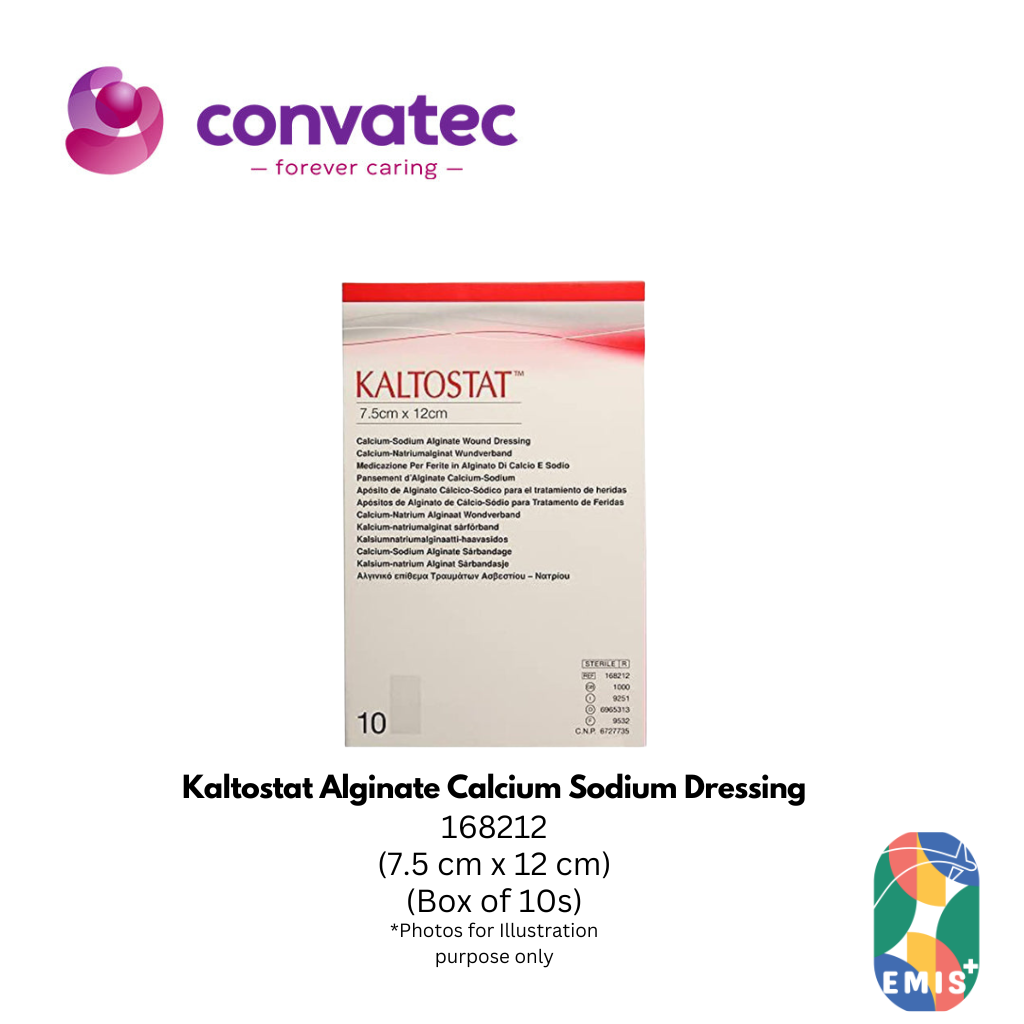
Kaltostat Alginate Calcium Sodium Dressing 7.5 x 12 cm Absorbent Wound Dressing
Kaltostat Alginate Calcium Sodium Dressing 7.5 x 12 cm Absorbent Wound Dressing
无法加载取货服务可用情况
Product Overview
KALTOSTAT is an established calcium sodium alginate wound dressing developed by ConvaTec for the primary management of moderate to heavily exuding wounds. The dressing is manufactured from naturally derived alginate fibres — a polysaccharide extracted from brown seaweed (Laminaria hyperborea) — processed into a soft, conformable non-woven sheet. The unique fibre composition of 80% calcium alginate and 20% sodium alginate delivers a controlled ion-exchange mechanism: as wound exudate contacts the dressing, sodium ions in the exudate displace calcium ions within the alginate matrix, converting the dry fibres into a firm, coherent gel that intimately conforms to the wound bed topography.
The high guluronic acid content of the alginate polymer chain is responsible for the firm gel character, which maintains structural integrity during wear and facilitates clean, atraumatic removal without leaving fibre residue in the wound bed. KALTOSTAT absorbs up to 20 times its own weight in wound fluid, creating an optimal moist wound environment that supports autolytic debridement and granulation tissue formation in accordance with the principles of moist wound healing established by Winter (1962) and endorsed by contemporary wound management guidelines (EWMA, WOCN Society). The dressing also contributes to haemostasis through calcium ion release, making it suitable for minor bleeding wounds and post-surgical donor sites.
Specifications
| Manufacturer | ConvaTec Ltd |
| Product Line | KALTOSTAT |
| REF / Catalogue Number | 168212 |
| Dressing Size | 7.5 cm x 12 cm (3 in x 4.75 in) |
| Shape | Rectangular, flat non-woven sheet |
| Composition | 80% calcium alginate, 20% sodium alginate (high guluronic acid content) |
| Absorption Capacity | Up to 20x its own weight in wound exudate |
| Gel Character | Firm, coherent gel — maintains structural integrity for clean removal |
| Haemostatic Properties | Yes — calcium ion release promotes haemostasis |
| Secondary Dressing Required | Yes — requires an appropriate secondary dressing (film, foam, or tape) |
| Maximum Wear Time | Up to 7 days (or as clinically indicated based on exudate level) |
| Sterility | Sterile, single use (gamma irradiated) |
| Latex Content | Latex-free |
| Regulatory | CE marked (EU MDR 2017/745 Class IIb), FDA 510(k) cleared, ISO 13485 certified manufacturing |
| Packaging | Box of 10, individually sterile-packaged |
Clinical Indications
- Pressure injuries (Category/Stage II through IV) with moderate to heavy exudate, as classified under NPUAP/EPUAP/PPPIA international staging guidelines
- Venous leg ulcers and arterial ulcers requiring high-capacity exudate absorption and moist wound bed maintenance
- Diabetic foot ulcers managed within multidisciplinary diabetic foot care pathways (IWGDF guidelines)
- Surgical wound donor sites where haemostatic properties and conformable wound coverage are required
- Superficial and partial-thickness burn wounds requiring absorbent primary dressings with atraumatic removal characteristics
- Post-debridement wound management where wound bed preparation and exudate control are clinical priorities
Frequently Asked Questions
How does the calcium-sodium ion exchange mechanism work in KALTOSTAT?
When wound exudate contacts the KALTOSTAT dressing, sodium ions present in the exudate displace calcium ions bound within the alginate fibre matrix. This ion exchange causes the dry alginate fibres to swell and form a hydrophilic gel that conforms to the wound surface. The released calcium ions contribute to local haemostasis by activating the clotting cascade. The high guluronic acid content of the alginate polymer ensures that the resulting gel is firm and coherent rather than amorphous, facilitating intact removal at dressing change without fibre residue.
Does KALTOSTAT require a secondary dressing?
Yes. KALTOSTAT is a primary wound contact dressing and must be covered with an appropriate secondary dressing to maintain position, control moisture vapour transmission, and provide bacterial barrier protection. Common secondary dressing choices include adhesive foam dressings (e.g., AQUACEL Foam), polyurethane film dressings, or retention tape, depending on wound location and exudate volume. The secondary dressing selection should be guided by institutional wound care protocols and the individual patient assessment.
What is the difference between KALTOSTAT and silver-containing alginate dressings?
Standard KALTOSTAT does not contain antimicrobial agents. For wounds with confirmed or suspected critical colonisation or infection, clinicians should consider silver-containing alginate alternatives that provide broad-spectrum antimicrobial activity alongside the exudate absorption properties of alginate. All antimicrobial dressing selections should align with local antimicrobial stewardship guidelines and be based on wound culture and sensitivity results where available.
How long can KALTOSTAT remain on the wound?
KALTOSTAT may be left in place for up to 7 days, depending on exudate volume and wound assessment findings. In heavily exuding wounds, more frequent dressing changes (every 1 to 3 days) may be necessary. The dressing should be changed when the gel has reached saturation or when clinical reassessment of the wound is indicated. The European Wound Management Association (EWMA) recommends individualised dressing change schedules based on wound assessment.
Can Singapore healthcare facilities purchase KALTOSTAT through EMIS?
Yes. EMIS (Essential Medical International Supplies Pte Ltd) is an authorised distributor of ConvaTec wound care products in Singapore. Hospitals, community hospitals, nursing homes, home care agencies, and private clinics can order KALTOSTAT and other ConvaTec products via emis.asia. Products are CE marked under EU MDR 2017/745 and distributed in compliance with the Health Sciences Authority (HSA) Singapore regulatory framework for Class C/D medical devices. Volume pricing is available for institutional procurement.
分享