Mölnlycke - Mepilex
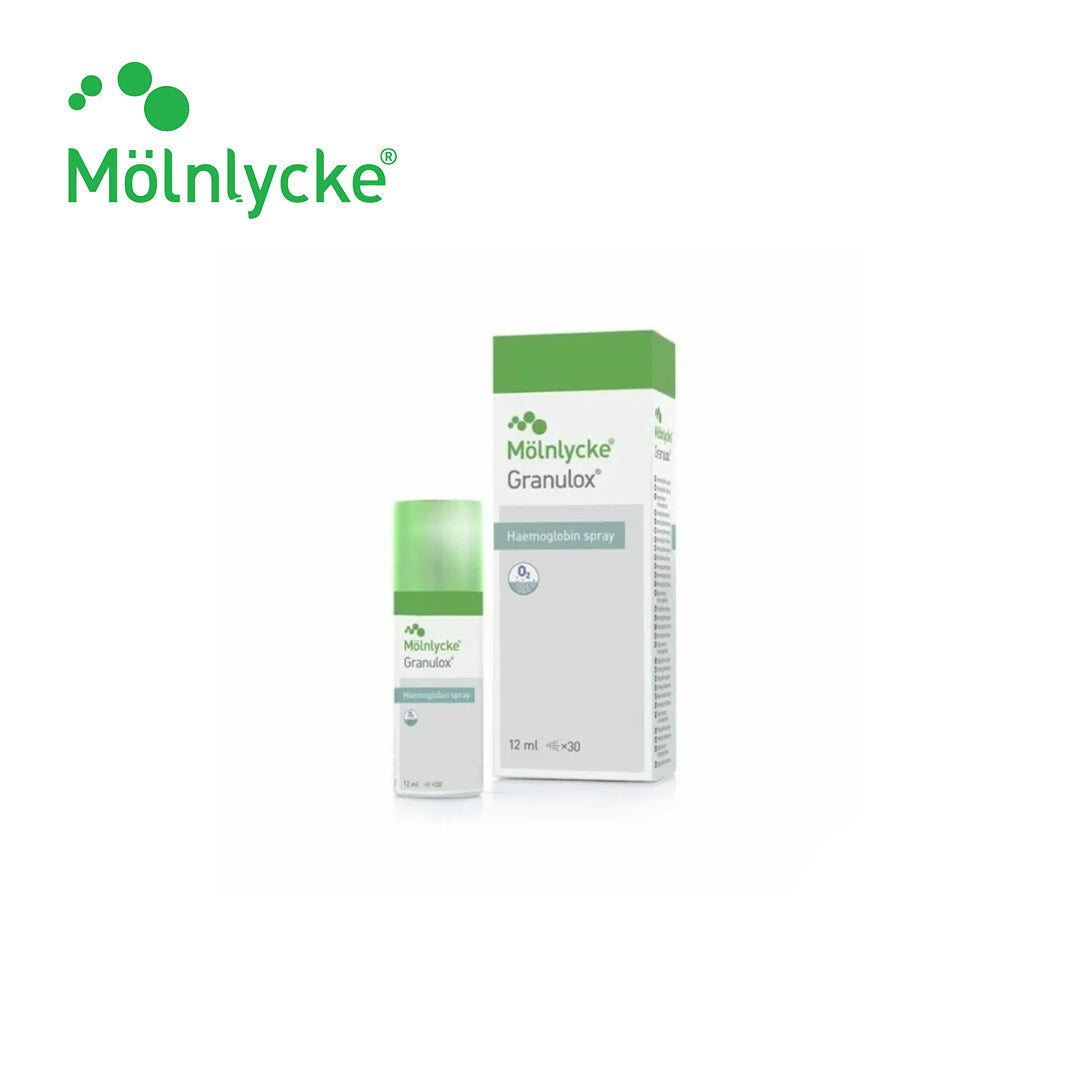
Molnlycke Granulox 12ml Oxygenating Wound Spray for Faster Healing
Molnlycke Granulox 12ml Oxygenating Wound Spray for Faster Healing
无法加载取货服务可用情况
Mölnlycke Granulox 12 mL Oxygenating Wound Spray addresses the fundamental driver of chronic wound chronicity: tissue hypoxia. By supplementing wound-bed oxygen supply through haemoglobin-mediated transport — independent of compromised microcirculation — Granulox restores the oxygen gradient needed for cellular repair mechanisms to function.
Technical Specifications
| Parameter | Specification |
|---|---|
| Active Component | Porcine haemoglobin ≥50 mg/mL in phosphate-buffered saline |
| Volume | 12 mL (metered-dose spray) |
| Oxygen Release Trigger | Tissue O₂ tension <20 mmHg (hypoxic wound environment) |
| Mechanism | Haemoglobin O₂ transport; atmospheric O₂ uptake → wound-bed release |
| Indications | Chronic venous leg ulcers, diabetic foot ulcers (DFU), pressure injuries, arterial ulcers, mixed aetiology ulcers |
| Application | Spray applied to wound bed before secondary dressing; 1–2 actuations per 10 cm² wound area |
| Change Frequency | At each dressing change (typically 2–3× per week for chronic wounds) |
| Biocompatibility | ISO 10993 tested; non-cytotoxic |
| Quality Management | ISO 13485:2016 |
| Singapore Registration | HSA-registered Class B medical device |
| Storage | 2–8°C refrigerated; do not freeze; use within 8 weeks after first actuation |
| Manufacturer | Mölnlycke Health Care AB, Sweden |
Clinical Q&A
Q: How does Granulox deliver oxygen to a wound without vascular access?
A: Granulox haemoglobin (porcine) has an oxygen-dissociation curve optimised for release at low pO₂. When sprayed onto the wound surface, haemoglobin molecules absorb atmospheric O₂ (pO₂ ~159 mmHg at sea level) and diffuse into the wound bed. As they encounter the hypoxic wound microenvironment (<20 mmHg), they release bound O₂ down the partial pressure gradient, increasing local tissue oxygenation independent of capillary blood flow.
Q: What clinical evidence supports Granulox for chronic venous leg ulcer healing?
A: RCT evidence (Wiegand et al., 2013; Frykberg et al., 2020) demonstrates statistically significant improvement in wound area reduction and complete closure rates in chronic VLUs and DFUs treated with Granulox as an adjunct to standard care versus standard care alone. Transcutaneous oxygen measurement (TcpO₂) studies confirm periwound pO₂ elevation within 30 minutes of application.
Q: Is Granulox safe for use in infected wounds or wounds requiring debridement?
A: Granulox is safe for use on critically colonised and clinically infected wounds as an adjunct to appropriate antimicrobial therapy and debridement. Increased oxygen tension in the wound bed also inhibits anaerobic organisms (e.g., Clostridium perfringens, Bacteroides) by raising local redox potential. Debridement should be performed prior to Granulox application to maximise haemoglobin-tissue contact.
Q: How is Granulox integrated into an existing dressing protocol?
A: Granulox is applied as a pre-dressing spray (1–2 actuations per 10 cm² wound area) directly to the clean wound bed before the primary contact layer is placed. It is compatible with all standard wound dressings including foam, hydrofibre, hydrocolloid, and antimicrobial silver dressings. It does not replace primary dressing selection but augments oxygen availability at each dressing change.
Q: What regulatory approvals apply to Granulox in Singapore?
A: Mölnlycke Granulox is registered with Singapore's Health Sciences Authority (HSA) as a Class B medical device under the Health Products Act. Manufacturing is certified to ISO 13485:2016 at Mölnlycke Health Care AB facilities. ISO 10993 biocompatibility evaluation confirms non-cytotoxic and non-sensitising profile for topical wound application.
Regulatory & Standards References
- ISO 13485:2016 — Medical devices quality management system; Mölnlycke manufacturing certification
- ISO 10993 — Biological evaluation; biocompatibility of haemoglobin topical spray confirmed
- HSA Singapore — Class B medical device registration; Health Products Act wound care device classification
- EWMA/WUWHS — Wound management guidelines supporting oxygenation therapy as adjunct for hypoxic chronic wounds
分享