BodyHealth
Perfect Amino Electrolytes NSF Certified for Sport
Perfect Amino Electrolytes NSF Certified for Sport
无法加载取货服务可用情况
Product Overview
PerfectAmino® Electrolytes NSF Certified for Sport is manufactured by BodyHealth, LLC (Tampa, FL, USA) and supplied in Singapore by Essential Medical International Supplies (EMIS+). The formulation pairs a precisely measured electrolyte profile with the BodyHealth PerfectAmino® essential amino acid matrix, which has been characterised in the literature as delivering a high net nitrogen utilisation (NNU) per serving owing to its 1:1 stoichiometric ratio of essential amino acids.
The NSF Certified for Sport® mark indicates third-party testing of every production lot for more than 290 substances banned by the World Anti-Doping Agency (WADA), as well as verification of label claims, GMP audit, and unannounced facility inspections. This level of independent assurance is required by Major League Baseball, the National Football League, the National Hockey League, and the Canadian Football League for any supplement permitted in their respective athlete-supplement programmes.
Specifications
| Manufacturer | BodyHealth, LLC (Tampa, FL, USA) |
|---|---|
| Format | Oral hydration powder; mix one scoop with water |
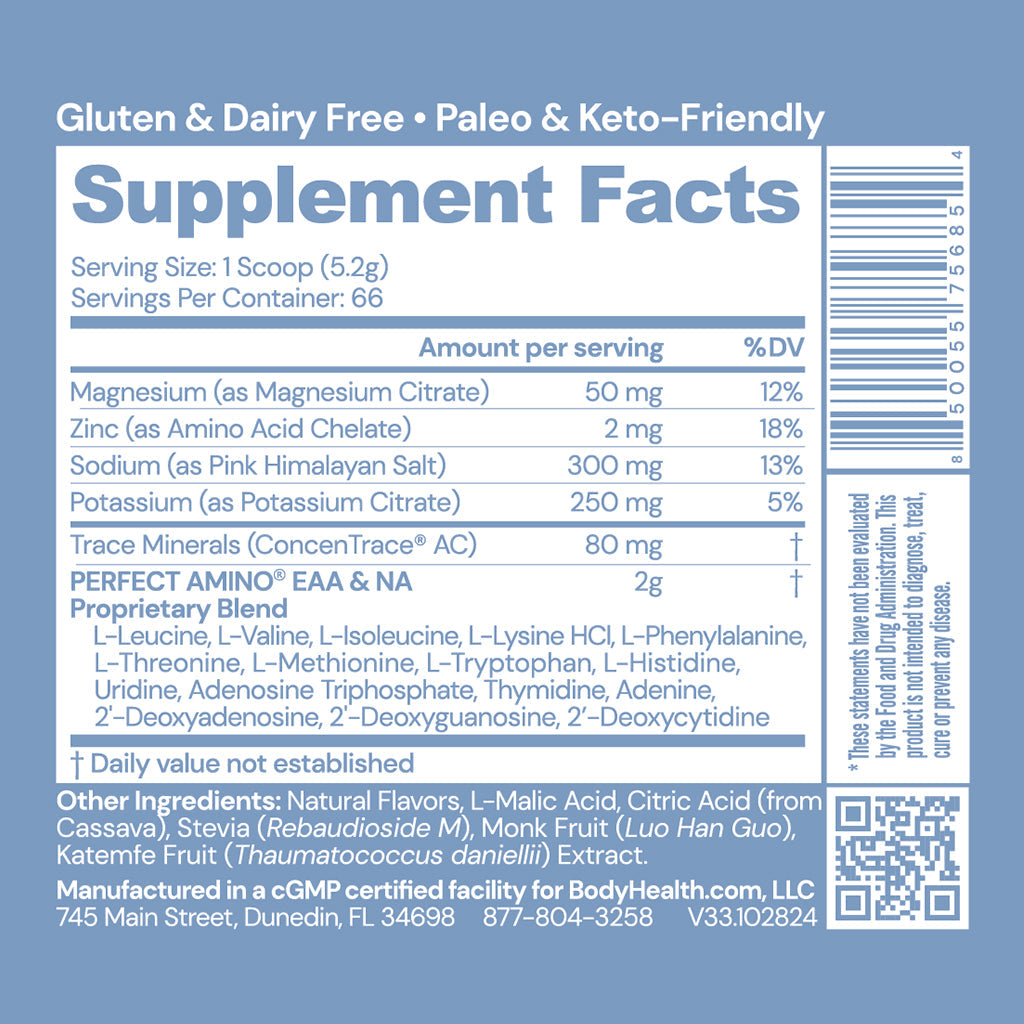
| Electrolytes per serving | Sodium 300 mg, Potassium 250 mg, Magnesium 50 mg, Zinc 2 mg, Trace minerals 80 mg |
| Amino acid load | 2 g PerfectAmino® (L-leucine, L-valine, L-isoleucine, L-lysine, L-phenylalanine, L-threonine, L-methionine, L-tryptophan) |
| Free of | Sugar, gluten, soy, dairy, MSG, erythritol, aspartame, neotame, maltodextrin, artificial sweeteners, artificial colours |
| Sweetener | Stevia leaf extract (Reb-A) and natural flavours |
| Third-party Certification | NSF Certified for Sport® (ANSI/NSF Standard 173, Annex S); banned-substance screening per WADA 2026 Prohibited List |
| Manufacturing Standard | 21 CFR Part 111 cGMP for dietary supplements; FDA-registered facility |
| Regulatory Status (Singapore) | Health supplement under HSA Health Products Act framework. Not a registered therapeutic product. |
| Storage | Store sealed below 25°C; protect from moisture |
Clinical Indications & Use Cases
- Endurance athletes (running, cycling, triathlon, rowing) replacing fluid and sodium losses during training sessions exceeding 60 minutes or in tropical heat (relevant for Singapore climate, average daily WBGT 28–31°C)
- Tested-pool, NCAA, professional or elite-amateur athletes who require NSF Certified for Sport® verification of every supplement they ingest
- Adults on therapeutic carbohydrate restriction (ketogenic, low-carb) managing transient electrolyte loss during keto-adaptation
- Adjunct hydration support during prolonged fasting protocols (per the supervising clinician)
- Post-illness rehydration in adults recovering from gastrointestinal fluid loss, when oral rehydration salts (WHO ORS) are not indicated and a low-osmolarity, sugar-free option is preferred
- Cabin-crew, military, and shift-working populations exposed to chronic mild dehydration and sodium turnover
Frequently Asked Questions
Q: What does NSF Certified for Sport® verify, and why does it matter for tested athletes?
A: NSF Certified for Sport® is the only third-party certification recognised by the major North American professional leagues (MLB, NFL, NHL, CFL) and used by US Olympic Committee training centres. It verifies (1) the absence of more than 290 substances on the WADA Prohibited List, (2) accurate label claims, (3) absence of unsafe contaminants (heavy metals, microbials), and (4) ongoing GMP compliance through unannounced facility audits. Athletes subject to in- or out-of-competition testing should preferentially select NSF Certified for Sport® products.
Q: How does the electrolyte profile compare with WHO ORS?
A: WHO Oral Rehydration Salts deliver sodium 75 mmol/L, potassium 20 mmol/L, citrate 10 mmol/L and glucose 75 mmol/L for the management of acute diarrhoeal dehydration. PerfectAmino® Electrolytes are positioned for exercise-associated and chronic mild electrolyte turnover, not for acute clinically significant dehydration; sodium per serving is 300 mg (~13 mmol) and the carbohydrate load is negligible. ORS remains the standard of care for moderate-to-severe dehydration.
Q: Are essential amino acids (EAAs) appropriate for hydration use?
A: Including a 2 g EAA load supports skeletal muscle protein synthesis during prolonged exercise, particularly in fasted training states. Trials in older adults (Volpi et al., Am J Clin Nutr 2003) demonstrated that EAAs, not non-essential amino acids, drive the muscle protein synthesis response. Athletes following high training volumes typically benefit from 5–10 g/day total EAA intake distributed across the day.
Q: How is this product regulated for sale in Singapore?
A: Under the Singapore Health Sciences Authority (HSA) framework, oral hydration and amino-acid powders are classified as health supplements under the Health Products Act. They are exempt from pre-market HSA registration but must comply with prohibited-substance lists, labelling rules, and post-market surveillance. EMIS+ holds supplier Certificates of Analysis and lot traceability records for each shipment.
Q: Is the product suitable for individuals on antihypertensives?
A: Sodium load per serving (300 mg, ~13 mmol) is modest but should be reviewed by the prescribing clinician for patients on sodium-restricted protocols, ACE inhibitors, ARBs, or potassium-sparing diuretics. Combined intake of potassium 250 mg per serving warrants caution in chronic kidney disease stages 3b–5.
Order this product and browse our full clinical range at emis.asia. Fast local delivery, genuine stock, and clinical guidance from registered nurses.
分享