Sigvaris
SIGVARIS Premium Cotton Compression Apparels
SIGVARIS Premium Cotton Compression Apparels
无法加载取货服务可用情况
Our Shopee store is a Preferred Seller, rated 4.9/5 from about 7,800 ratings.
Product Overview
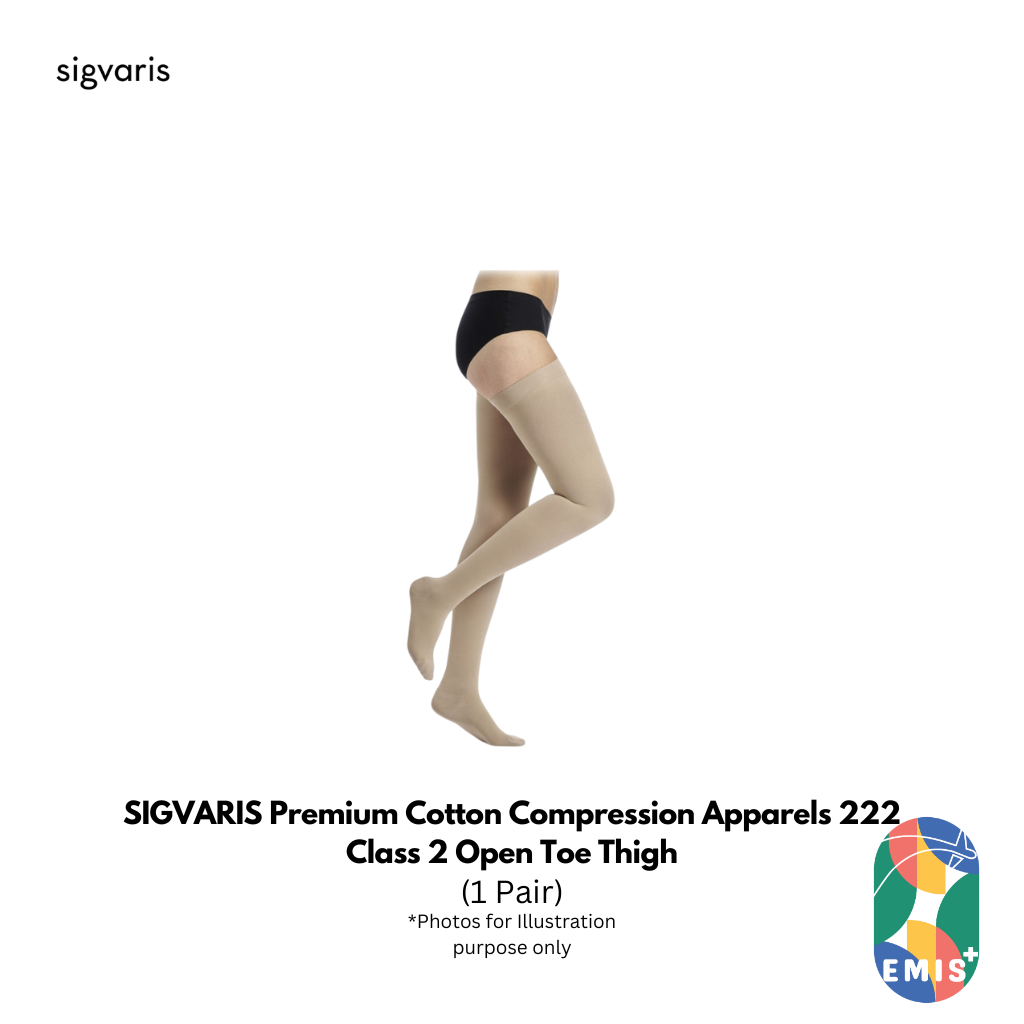
The SIGVARIS Premium Cotton 222 Class 2 Open Toe Thigh High compression stocking delivers 23–32 mmHg graduated compression across the full length of the lower limb, from the distal ankle to the proximal thigh. Graduated compression—highest at the ankle, progressively reducing toward the thigh—provides the mechanical venous return force that augments the calf muscle pump, reduces ambulatory venous pressure in the superficial and deep venous systems, and decreases capillary filtration pressure responsible for peripheral oedema. Class 2 (23–32 mmHg) represents the moderate-strength therapeutic tier of the international compression classification system, with a well-established evidence base across chronic venous insufficiency (CVI) stages C2–C4 per the CEAP clinical classification, lymphoedema maintenance, and post-thrombotic syndrome management. The open-toe design permits clinical monitoring of distal perfusion and accommodates patients with toe deformities or altered digital sensitivity.
The garment's 50% cotton composition (43% Sea Island cotton + 7% Supima cotton) provides clinically meaningful thermoregulatory advantage over synthetic-only compression garments in equatorial climates. Sea Island cotton fibres absorb excess moisture and release it via evaporative cooling, reducing the thermal load at the skin-garment interface during Singapore's ambient temperatures of 26–32°C and relative humidity of 70–90%. Reduced thermal discomfort is a documented driver of improved compression therapy adherence, a critical determinant of long-term clinical outcomes in CVI and lymphoedema management. The garment's pressure accuracy is verified by independent testing to RAL-GZ 387/1 standards at the Hohenstein Institute, a Deutsche Akkreditierungsstelle (DAkkS)-accredited testing laboratory, ensuring consistent therapeutic pressure delivery across production batches.
Product Specifications
| Parameter | Details |
|---|---|
| Manufacturer | SIGVARIS Group (Switzerland) |
| Product Line | Cotton 222 – Premium Cotton Series |
| Style | Thigh High, Open Toe |
| Compression Class | Class 2: 23–32 mmHg (graduated, ankle-to-thigh) |
| Fibre Composition | 43% Sea Island Cotton, 39% Nylon, 11% Spandex (elastane), 7% Supima Cotton |
| Cotton Contact Layer | 100% cotton against skin (inner layer) |
| Toe Design | Open toe (permits distal perfusion monitoring; accommodates digit deformity) |
| Latex Content | Latex-free |
| CE Marking | Yes – EU Medical Device Regulation (MDR) 2017/745 |
| Quality Standard | RAL-GZ 387/1 (Medical Compression Hosiery Quality Assurance); independently verified by Hohenstein Institute |
| Manufacturing Quality | ISO 13485:2016 (Medical Devices Quality Management System) |
| Pressure Testing Standard | CEN 15831 / RAL-GZ 387/1 pressure measurement methodology |
| Sterility | Non-sterile (external use) |
| Regulatory – Singapore | Medical device; registration under HSA Health Products (Medical Devices) Regulations 2010; Class A or B depending on therapeutic claim; CE marking supports abridged evaluation pathway |
| Product Lifespan | 12–18 months with proper care (daily washing, air drying) |
| Retail Price (Singapore) | SGD $175.61 per pair |
Clinical Indications and Key Applications
- Chronic venous insufficiency (CVI) — CEAP C2–C4: Primary clinical indication per the International Consensus Statement on Compression Therapy. Class 2 (23–32 mmHg) compression reduces ambulatory venous hypertension, decreases capillary filtration, and reduces limb oedema volume in CVI stages C2 (varicose veins), C3 (oedema), and C4 (skin changes including lipodermatosclerosis and atrophic blanche).
- Lymphoedema maintenance phase: Following intensive decongestive physiotherapy (IDP/CDT), Class 2 compression maintains achieved limb volume reduction in the long-term maintenance phase. Recommended per International Society of Lymphology (ISL) consensus guidelines; the cotton composition reduces skin irritation risk associated with prolonged hosiery wear in lymphoedema patients.
- Post-thrombotic syndrome (PTS) symptom management: Daily graduated compression reduces PTS-associated pain, heaviness, and oedema. The SOX trial (NEJM 2014) evaluated compression for PTS; Class 2 compression remains recommended for symptom management in established PTS per Singapore National Heart Centre venous disease guidelines.
- DVT prophylaxis in medically ill and hospitalised patients: Anti-embolism-class compression (typically 18–23 mmHg) is the minimum for prophylaxis, but Class 2 garments are used in ambulatory patients with moderate thrombotic risk factors (prolonged travel, post-surgical recovery, immobility) where higher-grade compression is tolerated.
- Post-operative lower limb oedema management: Following orthopaedic procedures (total knee/hip arthroplasty), varicose vein surgery, or vascular reconstruction, Class 2 graduated compression reduces post-operative limb oedema and improves patient mobility and recovery velocity.
- Thermoregulation in tropical climates: Cotton composition provides active moisture management in Singapore's equatorial climate, supporting patient compliance with prescribed compression therapy durations — a clinically documented adherence barrier in warm, humid environments.
Frequently Asked Questions
Q: What is the clinical difference between Class 1 (18–21 mmHg) and Class 2 (23–32 mmHg) compression, and how is the appropriate class selected?
A: Class selection is based on the severity of venous or lymphatic pathology and patient-specific factors including arterial status, skin integrity, and mobility. Class 1 (18–21 mmHg) is indicated for mild varicosity (CEAP C1–C2), leg fatigue, and prophylactic use in low-risk patients. Class 2 (23–32 mmHg) is indicated for CVI stages C2–C4, symptomatic oedema, lymphoedema maintenance, and post-thrombotic syndrome. Absolute contraindications for compression therapy include severe peripheral arterial disease (ABPI <0.6); healthcare professionals should perform ankle-brachial pressure index (ABPI) measurement before prescribing Class 2 or above in patients with known or suspected arterial insufficiency. Clinical prescribing guidance is available from the Singapore Venous Disease Group and the Wound Care Association of Singapore.
Q: How should patients with sensitive skin or dermatitis be fitted with cotton compression garments?
A: The SIGVARIS Cotton 222 series is specifically indicated for patients with skin sensitivity, including those with contact dermatitis, atopic skin, or prior sensitisation to synthetic-only compression garments. The 100% cotton inner contact layer eliminates synthetic fibre friction on sensitised skin. Patients with active dermatitis, weeping wound areas, or significant oedema-related skin breakdown should receive pre-prescribing dermatological assessment; a flat-knit custom-fabricated garment may be preferred if standard round-knit sizing cannot achieve adequate fit without skin pressure gradients at skin fold areas. Donning gloves are recommended to prevent snagging and to maintain skin hygiene during application.
Q: What is the correct technique and timing for applying a thigh-high compression stocking?
A: Apply the stocking in the morning before rising, while limb oedema is at its minimum. Invert the garment to the heel cup, insert the foot positioning the heel correctly, then progressively unfold upward using smooth upward rolling motions — avoid bunching or twisting. Donning aids (stocking butler frame or silk donning glove) reduce mechanical stress on the garment and decrease patient effort, improving compliance in elderly or arthritic patients. The silicone top band should be positioned 2 finger-widths below the gluteal fold. All compression creases must be smoothed to ensure even pressure distribution; any persistent fold creates a localised high-pressure point that may cause tissue damage. Patients with limited hand strength or dexterity should be assessed for donning aid prescription. SIGVARIS Donning Aids (including the SIM-SLIDE range stocked at EMIS Singapore) are compatible with this garment.
Q: How does Singapore HSA regulate medical compression stockings, and what documentation should clinics request from suppliers?
A: Under Singapore's Health Products (Medical Devices) Regulations 2010, medical compression stockings claiming therapeutic effects (CVI treatment, DVT prevention) are classified as medical devices requiring HSA registration. Class A devices undergo a registration process via HSA's online portal; CE-marked devices from jurisdictions with established regulatory frameworks (EU, US, Canada, Australia, Japan) may be eligible for the abridged evaluation pathway. Clinics and hospitals procuring compression garments should request from the supplier: (1) HSA registration certificate or registration number from the Singapore Medical Device Register (SMDR); (2) CE certificate and technical file reference; (3) RAL-GZ 387/1 compliance documentation; (4) ISO 13485 quality management certificate. EMIS Singapore (emis.asia) supplies SIGVARIS products as an authorised distributor; HSA registration documentation is available upon request.
Q: What care instructions maximise garment longevity and maintain therapeutic compression properties?
A: Wash daily in lukewarm water (maximum 40°C) using a mild detergent, either by hand or in a machine on a gentle cycle using a laundry net. Fabric softener must not be used — it degrades elastane fibre cross-links and reduces compression properties over time. Air-dry flat or hanging; do not tumble dry, iron, or expose to direct heat sources or prolonged direct sunlight, all of which degrade spandex elasticity. Inspect monthly for loss of elasticity, pilling, or reduced compression (garment feels looser than initial fit). Replace every 12–18 months under normal therapeutic wear conditions. Patients should ideally own two pairs to allow daily rotation, permitting thorough drying between uses — particularly important in Singapore's humid climate where inadequate drying promotes fibre degradation and bacterial growth.
Share