AiYiSheng
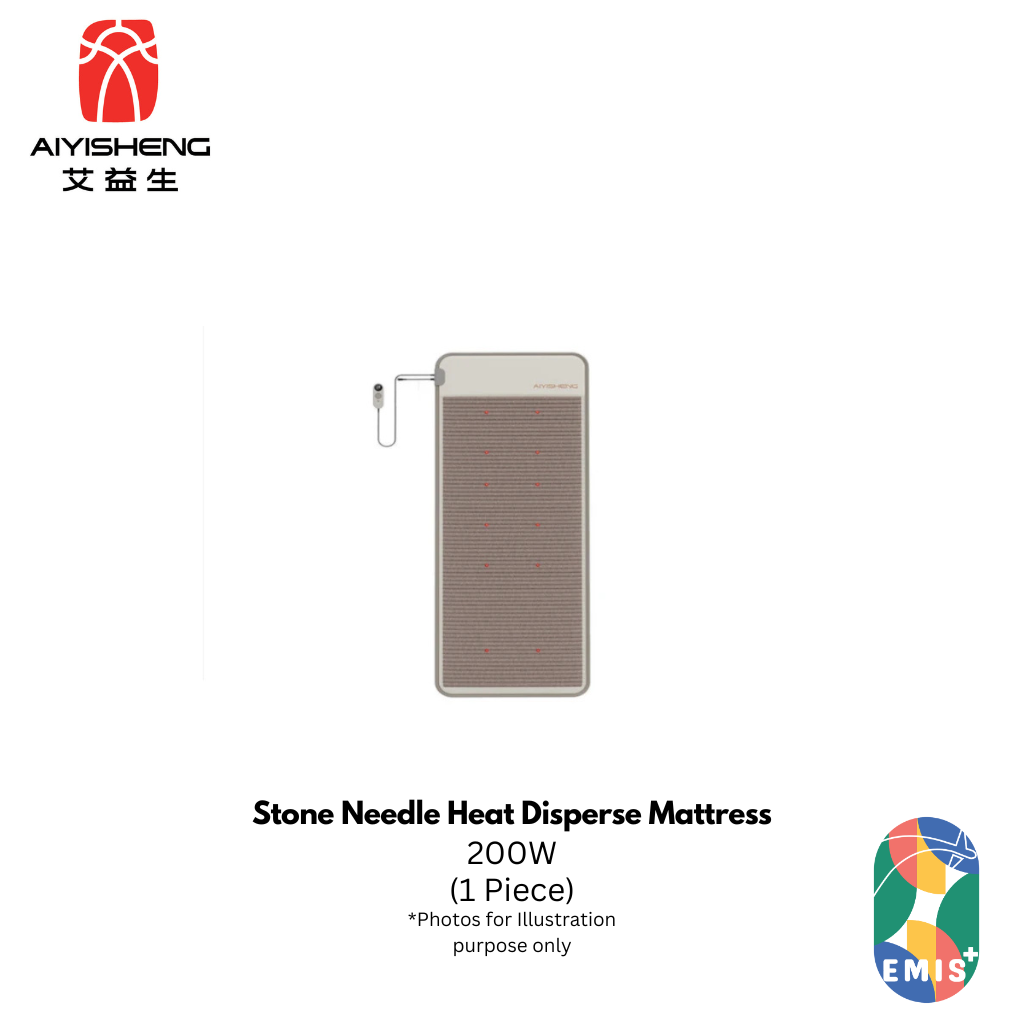
Stone Needle Heat Disperse Mattress
无法加载取货服务可用情况
Stone Needle Heat Disperse Mattress — AiYiSheng. SKU: MS-TL-0004. SGD 1,099. Full-body therapeutic wellness mattress constructed with natural bian stone (Chinese: 砭石 — volcanic mineral silicate compound) delivering simultaneous far-infrared radiation, negative ion emission, and zonal thermotherapy across the full dorsal body surface. Technical specifications: adjustable temperature range 30°C–55°C; programmable timer 2–12 hours; three independently controllable zonal heating regions (shoulders/upper back, waist/hips, legs); device weight 9.0 kg; 36V low-voltage safe electrical system; V0 UL94 grade flame-retardant construction; removable washable sweat-resistant hygienic cover. Bian stone properties: emits far-infrared radiation at 8–14 micrometre wavelength; releases negative ions (approximately 1,500–3,000 ions/cm3); trace mineral composition (silicon dioxide, calcium, magnesium, iron oxides) with demonstrated piezoelectric properties. Mechanism: far-infrared penetrates subcutaneous tissue 2–5 cm, promoting collagen alignment, mitochondrial cytochrome c oxidase activation, and sustained vasodilation; negative ions shift autonomic balance toward parasympathetic dominance; thermal zonal delivery across full dorsal surface provides comprehensive meridian warming along the Du Mai, Bladder, and Dai Mai pathways. Indications: chronic back pain, spinal degeneration, lumbar muscle strain, cold-Bi syndrome (TCM), menstrual cold patterns (Gong Han), digestive Yang deficiency, cold-constitution (Yang-xu) disorders, persistent fatigue, poor peripheral circulation. Contraindication: Yin-deficiency patterns — avoid prolonged or overnight use. Singapore. IEC 60601-1 compliant.
Stone Needle Heat Disperse Mattress: Technical Specifications
| Parameter | Specification | Clinical / Functional Note |
|---|---|---|
| SKU / Model | MS-TL-0004 | Manufacturer: AiYiSheng; product class: bian stone far-infrared full-body therapeutic mattress |
| Stone Material | Natural bian stone (砭石 — volcanic silicate mineral); authenticated mineral composition including SiO2, CaO, MgO, Fe2O3 trace oxides | Bian stone is one of the earliest documented Chinese therapeutic tools (referenced in Huangdi Neijing); emits far-infrared at 8–14 micrometre wavelength and negative ions at approximately 1,500–3,000 ions/cm3 when heated |
| Temperature Range | 30°C–55°C; fine-increment adjustable thermostatic control | 30–38°C: gentle warming for daily maintenance, sleep enhancement, cold-constitution warming; 38–45°C: therapeutic far-infrared and vasodilatory range for pain and circulation; 45–55°C: maximum thermal dose — limit session to 20 minutes; avoid in neuropathic patients |
| Timer | 2–12 hours programmable | 2–4 hour sessions: targeted therapeutic use; 8–12 hour overnight setting: gentle 30–35°C Yang warming for cold-constitution management; note Yin-deficiency contraindication for overnight use |
| Heating Zones | 3 independently controlled zones: Zone 1 — shoulders and upper back (T1–T6); Zone 2 — waist and hips (T12–S2); Zone 3 — legs (bilateral posterior thigh to calf) | Zonal independence allows cervicothoracic, thoracolumbar, or lower-extremity-specific treatment without full-body thermal load; Zone 2 (waist/hip) covers BL23 Shenshu, GV4 Mingmen, and Du Mai primary Yang points |
| Far-Infrared Emission | 8–14 micrometre wavelength far-infrared; penetration depth 2–5 cm subcutaneous | Far-infrared at 8–14 micrometres resonates with water molecule absorption band in biological tissue; activates cytochrome c oxidase (mitochondrial Complex IV) — increasing ATP synthesis; promotes collagen realignment in fascia; vasodilates dermal microvascular networks independently of conductive heat |
| Negative Ion Emission | Approximately 1,500–3,000 negative ions/cm3 when heated | Negative ion exposure associated with autonomic parasympathetic shift, serotonin regulation, and reduction in airborne particulate; outdoor forest environments produce 1,000–2,000 ions/cm3; mattress delivers equivalent exposure at sleep surface level |
| Electrical Safety | 36V low-voltage system; V0 UL94 grade flame-retardant construction; IEC 60601-1 compliant | 36V eliminates lethal shock risk at body contact; V0 flame retardancy (UL94 standard) — material self-extinguishes within 10 seconds after flame removal; appropriate for overnight and unattended operation at low-temperature settings |
| Hygiene Design | Removable washable sweat-resistant cover; soft-touch surface; easy-clean wipe-down construction | Machine-washable cover maintains hygiene through perspiration and regular use; critical for overnight thermal applications where sustained body contact promotes moisture accumulation |
Clinical Q&A: Stone Needle Heat Disperse Mattress
What is bian stone and what are its documented therapeutic properties?
Bian stone (砭石, pronounced "bianshi") is a natural volcanic silicate mineral first documented in Chinese therapeutic texts circa 4,000 BCE and referenced in the foundational medical canon Huangdi Neijing (Yellow Emperor's Classic of Internal Medicine) as one of the five classical therapeutic tools alongside acupuncture needles, moxibustion, cupping, and massage. Its mineral composition — predominantly silicon dioxide (SiO2) with trace oxides of calcium, magnesium, iron, and over 30 microelements — confers three therapeutically relevant physical properties when heated: (1) far-infrared emission at 8–14 micrometre wavelength, within the optimal biological absorption band for tissue penetration (versus 3–5 micrometre mid-infrared which absorbs at the skin surface); (2) negative ion release — heated bian stone generates approximately 1,500–3,000 negative ions/cm3, attributable to piezoelectric and thermoelectric properties of the silicate crystal structure; (3) ultrasonic wave emission at approximately 1.6 MHz — documented in laboratory measurements and attributed to the crystalline piezoelectric microstructure. These properties collectively position bian stone as a multiphysical therapeutic material that passive heating activates simultaneously, distinguishing it from ceramic or synthetic thermal elements that emit only conductive and convective heat.
How does far-infrared therapy at 8–14 micrometres differ mechanistically from standard heat pad therapy?
Standard heating pads transfer thermal energy through conduction and convection at the skin surface — the heat gradient is maximal at the epidermis and declines rapidly with tissue depth, reaching minimal penetration beyond 1–2 mm. Far-infrared radiation at 8–14 micrometres interacts differently: at this wavelength, photon energy resonates with the water-molecule O-H bond stretching frequency in biological tissue, enabling photon absorption 2–5 cm subcutaneously. This depth is sufficient to reach the erector spinae muscles, multifidus, thoracolumbar fascia, and paraspinal ligaments — therapeutic targets for chronic back pain that surface conductive heat cannot directly reach. At the cellular level, far-infrared at this wavelength activates cytochrome c oxidase (Complex IV of the mitochondrial electron transport chain) — increasing mitochondrial membrane potential, ATP synthesis, and reactive oxygen species scavenging. Research in the field of photobiomodulation (Hamblin et al., 2017) demonstrates this mitochondrial activation drives collagen synthesis, fibroblast proliferation, and anti-inflammatory cytokine modulation in irradiated tissue. The bian stone mattress combines this photobiomodulatory effect with the thermal analgesic and vasodilatory effects of surface heat — a dual-mechanism approach standard heating pads lack.
Which Du Mai and Bladder meridian points does full-dorsal zonal heating address?
In TCM, the Du Mai (Governor Vessel) runs along the posterior midline from GV1 (Changqiang, coccygeal tip) to GV20 (Baihui, vertex) — it governs Yang Qi circulation throughout the entire body. The Bladder meridian (Foot Taiyang) runs bilaterally along the erector spinae from BL10 (Tianzhu, occiput) to BL67 (Zhiyin, fifth toe), with two inner and outer branches providing full paraspinal innervation. The stone needle mattress zonal coverage addresses: Zone 1 (shoulders/upper back) — BL11-BL17 (Back-Shu points for Heart, Lung, Pericardium, Liver, Gallbladder, Diaphragm), GV14 (Dazhui, master Yang point); Zone 2 (waist/hips) — BL23 (Shenshu, Kidney Back-Shu — primary point for lumbar pain, Kidney Yang deficiency, fatigue, and reproductive health), BL25 (Dachangshu), GV4 (Mingmen, Gate of Life — primary Yang tonification), GV3 (Yaoyangguan, lumbar Yang gate); Zone 3 (legs) — BL36-BL57 (posterior thigh to calf, including BL40 Weizhong — "command point" for back pain, master of the Bladder meridian). Full-dorsal activation simultaneously treats all Back-Shu organ points — the most comprehensive meridian tonification available in moxibustion therapy.
What temperature and session duration protocols are appropriate for specific conditions?
Protocol recommendations by condition. Chronic low back pain (lumbar degeneration, muscle strain): Zone 2 at 40–44°C, 30–45 minutes, daily for 2 weeks then 4–5 sessions/week maintenance. Cold-constitution Yang deficiency (feeling persistently cold, low energy, cold extremities — TCM Yang-xu pattern): all zones at 35–40°C, 1–2 hours daily; overnight use at 30–35°C appropriate if Yin-deficiency pattern excluded. Insomnia and autonomic nervous system dysregulation: all zones at 33–38°C for 45–60 minutes before sleep — leverages negative ion parasympathetic shift and thermal relaxation to enhance sleep onset latency. Menstrual cold patterns (Gong Han, uterine cold with dysmenorrhoea): Zone 2 (waist/hip) at 40–44°C, used for 5–7 days pre-menstrually; continue at 38–42°C during menstruation if not contraindicated by patient comfort. Fatigue and post-exercise recovery: all zones at 38–42°C for 20–30 minutes post-exercise — promotes lactate clearance and muscle glycogen resynthesis via increased paraspinal and leg microcirculation. Maximum temperature (45–55°C): reserve for targeted short sessions (15–20 minutes maximum), supervised by practitioner, not suitable for overnight or unattended use.
What contraindications apply and how should patients with Yin deficiency modify use?
Absolute contraindications: pregnancy; active malignancy overlying or adjacent to treated zones; implanted electrical devices (pacemakers, spinal cord stimulators, sacral nerve stimulators); acute inflammatory conditions (active arthritis flare, acute osteomyelitis, discitis); skin integrity compromise over the contact surface; fever (body temperature above 38°C — additional thermal load worsens systemic hyperthermia). Yin-deficiency constitutional contraindication (TCM Yin-xu): this is the most clinically important use restriction specific to bian stone therapy. TCM Yin-xu patterns present with five-palm heat (palmar/plantar and sternal warmth), night sweats, dry mouth, afternoon tidal fevers, insomnia with heat sensation, and a red tongue with thin or absent coating. Sustained moxibustion-equivalent heat in Yin-xu patients exhausts residual Yin, worsening heat symptoms, night sweats, and agitation. For Yin-xu patients who wish to use the mattress: limit sessions to 20–30 minutes maximum at 30–35°C (lowest thermal range only); avoid overnight use entirely; use Zone 3 (legs) rather than Zone 2 (lumbar Yang points) to minimise Yang tonification; follow with Yin-nourishing herbs (Liuwei Dihuang Wan) as prescribed by a registered TCM practitioner.
Regulatory & Standards Framework: Electrical safety per IEC 60601-1:2005+A1:2012 (Medical electrical equipment — General requirements for basic safety). Low-voltage system (36V) compliant with IEC 60364 low-voltage installation standards. Flame-retardancy: UL 94 V0 (material self-extinguishes within 10 seconds after flame removal — highest residential appliance safety rating). ISO 13485:2016 quality management for medical device manufacturing. Singapore Health Sciences Authority (HSA) general controls for Class A/B external body-contact therapeutic devices. Far-infrared thermal therapy: ISO 13485 and ISO/TC 215 Health Informatics framework applicable. Bian stone (砭石) therapeutic material first documented in Huangdi Neijing (Yellow Emperor's Classic of Internal Medicine, circa 100 BCE). Far-infrared photobiomodulation: Hamblin MR, Photochemistry and Photobiology 2017; Vatansever F et al., Photonics and Lasers in Medicine 2013. Negative ion therapy: Perez V et al., BMC Psychiatry 2013. Singapore Traditional Chinese Medicine Practitioners Act (Cap. 333A) and TCM Practitioners Board regulatory framework.
分享